
Working remotely from Mexico: separate the visa and tax questions
Working remotely from Mexico requires separate consideration of permission to stay, permission to perform your activities, employer approval, and cross-border taxes. A U.S. job or paycheck does not answer all of those questions. Qualified independent immigration and tax professionals should assess the proposed arrangement, while your employer reviews its own requirements. Destination and property planning belongs alongside that review, not in place of it.
Table of Contents
- Can you work remotely in Mexico for a U.S. company?
- What does a Mexico digital nomad visa search actually need to resolve?
- Employer approval needs its own review
- What tax questions belong in a cross-border review?
- Compare a working visit, a relocation, and independent work
- Make the professional discussion concrete
- Keep destination fit separate from legal and tax eligibility
- Frequently Asked Questions
Working remotely from Mexico can mean answering occasional messages during a visit, maintaining a full work schedule during an extended stay, or relocating while keeping a U.S. job. Those plans raise different questions, even if the laptop and employer remain the same.
The useful starting point is the arrangement itself: where you will work, what you will do, how you are engaged, and whether Mexico will become your everyday home. This article provides general education, not legal, immigration, tax, or financial advice. Use appropriately qualified independent professionals for an assessment of your circumstances and current requirements.
Can you work remotely in Mexico for a U.S. company?
The answer requires an assessment of your proposed activities and circumstances, rather than a blanket yes or no. A qualified independent immigration professional can evaluate the Mexican permission question; your employer must separately evaluate whether it authorizes the arrangement.
Permission to enter or remain in a country, permission to perform particular activities, and an employer's consent address different decisions. For planning purposes, keep each answer attached to the question it actually resolves.
For example, an employer's remote-work policy might describe flexibility about your workspace without addressing international work. Similarly, evidence of income may be relevant to an immigration discussion without establishing what work a particular status permits.
A useful description of your plan includes your nationality, intended living arrangement, work duties, employer or client locations, and expected travel pattern. It should also distinguish between a visit with some work activity and a move built around a continuing work schedule.
Advice written for a Mexican citizen working from their home country does not establish the position of an American moving to Mexico. The direction of the move and the person's circumstances matter to the question being asked.
Work permission and employer authorization are separate from choosing where everyday life in Mexico would suit you.
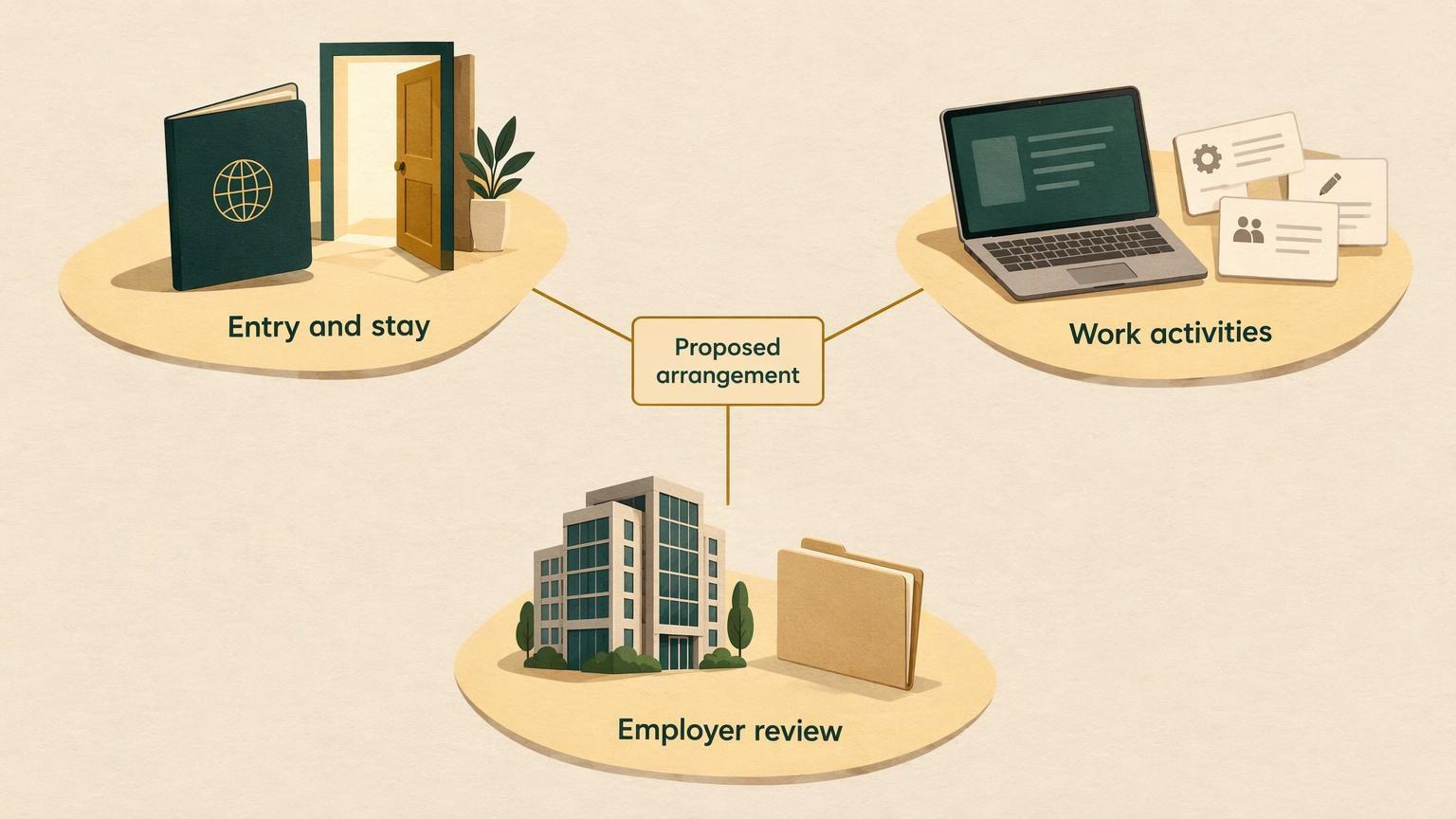
Illustration of three separate areas linked to Proposed arrangement: Entry and stay, Work activities, and Employer review.
What does a Mexico digital nomad visa search actually need to resolve?
A search for a digital nomad visa in Mexico is a starting point, not an eligibility determination. The useful result is an explanation from a qualified independent immigration professional of the current category, permitted activities, and application process relevant to the proposed stay.
The phrase can blur several separate interests: having enough time in Mexico to establish a routine, supporting an application with foreign income, and continuing to work. A description that addresses one interest may leave the others unanswered.
Rather than treating an online label as the full answer, the professional discussion should connect a particular immigration category to your actual duties. Employment, independent services, and business management deserve accurate descriptions, not the single shorthand of "working on a laptop."
Duration and activities are different questions
Someone asking how long a U.S. employee can work remotely from Mexico may be asking about permitted stay length, employer policy, or tax treatment. An answer about duration should identify which of those it covers.
A proposed return date helps define the plan, but it does not replace a review of activities. Likewise, an immigration assessment does not establish the tax treatment of the same stay.
An application discussion is not an approval
Eligibility, supporting documents, fees, appointment procedures, and timing require current verification. A qualified professional can explain the applicable process without treating an application or a planning conversation as a guaranteed outcome.
That distinction matters when housing and travel decisions depend on the result. A destination preference can remain useful while the immigration questions are being evaluated.
Beyond the visa search, consider what you want your routine in Mexico to look like.
Employer approval needs its own review
The employer conversation concerns more than whether you can attend meetings from another location. It should establish whether the organization has reviewed the proposed international arrangement and who is responsible for its approval.
Describe the country, intended travel pattern, duties, and whether the arrangement is temporary or intended to continue. That gives the employer a concrete proposal rather than a broad request to "work from anywhere."
Questions for the employer's relevant teams include payroll handling, employment documentation, benefits terms, and access to company systems or client information. Those are topics for review, not evidence that a particular obligation necessarily applies.
Work duties deserve particular attention. Serving existing clients, managing people, negotiating contracts, and running a business are different activities; a company-level professional assessment can consider what those activities mean for the organization.
The trade-off is practical: an arrangement that suits your personal life may not fit the employer's approved way of operating. Destination flexibility cannot solve an employer restriction, and personal tax advice cannot authorize company systems access.
Independent contractors have a different counterpart in this discussion. They may need to consider client agreements and their own business arrangements rather than rely on an employee travel policy.
What tax questions belong in a cross-border review?
A qualified independent tax professional familiar with both countries can assess potential Mexican and U.S. obligations together. The review should distinguish reporting, tax owed, payroll withholding, and any available relief instead of treating them as one question.
"My employer is American" and "my salary goes to a U.S. account" describe parts of the arrangement. They do not describe the whole fact pattern: where the work happens, where you maintain a home, your citizenship or other status, and your continuing U.S. ties also belong in the discussion.
The following comparison identifies different layers of review. It is not a determination that every layer applies to every remote worker.
| Review area | Question to resolve | Why a separate answer matters |
|---|---|---|
| Mexican individual taxation | How would Mexico treat the proposed living and working arrangement? | A U.S. payroll description does not answer the Mexican analysis. |
| U.S. federal taxation | What reporting and payment rules apply to this person abroad? | A foreign move is not itself a complete filing analysis. |
| U.S. state taxation | How are continuing ties and residency treated by the relevant state? | The federal discussion does not settle the state question. |
| Employer or business taxation | Does the work arrangement require company-level review? | The worker's personal return is separate from the organization's position. |
Immigration residency and tax residency need separate explanations
In a professional review, the word "resident" should identify the system being discussed. An immigration document and a tax-residency assessment address different questions; the professional should explain how each applies to the proposed arrangement.
Travel dates are useful evidence, but the discussion should also describe homes, work patterns, family circumstances, and continuing ties. Avoid reducing the review to a single day-count slogan.
Filing, payment, and relief are not interchangeable
A filing question asks what information must be reported. A payment question asks what is owed after the applicable calculation, while a relief question considers whether a credit, exclusion, or treaty provision is relevant.
Those concepts help you understand a professional explanation; they are not a basis for selecting a tax strategy yourself. Availability, eligibility, interactions, and documentation need assessment under current rules.
Compare a working visit, a relocation, and independent work
The planning choice is not simply a shorter stay versus a longer stay. It is whether the proposed work and living arrangement has dependencies that can be evaluated before you commit to it.
A visit may help you learn about everyday life without settling whether Mexico can become your working home. A relocation can provide a fuller routine, but it ties more decisions to the immigration, employment, and tax assessment.
| Arrangement | Useful distinction | Central review | Planning trade-off |
|---|---|---|---|
| Working visit | A defined visit rather than an intended move | Permitted activities and employer authorization for the proposed visit | Useful lifestyle exposure, but limited evidence about long-term fit |
| Relocation with a U.S. job | Mexico becomes the intended everyday home | Immigration, employer, and cross-border tax assessments | A fuller routine with more decisions depending on professional review |
| Independent work from Mexico | The person provides services or operates a business | Immigration, client agreements, and business tax questions | Control over work does not replace compliance analysis |
A working example: everyday life without assuming the job can move
Say you have a U.S. job and want to explore living in Puerto Vallarta. Its established international community, neighborhood character, and everyday city services appeal because you want a home routine rather than only a resort experience.
Your employer has approved domestic remote work but has not assessed Mexico. A relocation plan would depend on an employer decision as well as independent immigration and tax review; choosing housing cannot resolve those dependencies.
A visit without performing work would explore the lifestyle question without depending on remote-work authorization, although entry requirements still need separate verification. A working visit would need its own assessment rather than inherit permission from the domestic policy.
For this example, a lifestyle visit is the better-defined planning option while international work remains under review. That is a comparison of what each option tests, not an immigration recommendation or a finding of eligibility.
| Arrangement | Review focus | Planning trade-off |
|---|---|---|
| Working visit | Permitted activities; employer approval | Lifestyle exposure; limited long-term fit |
| Relocation with a U.S. job | Immigration, employer, cross-border tax | Fuller routine; more review dependencies |
| Independent work from Mexico | Immigration, client agreements, tax | Work control does not replace compliance |
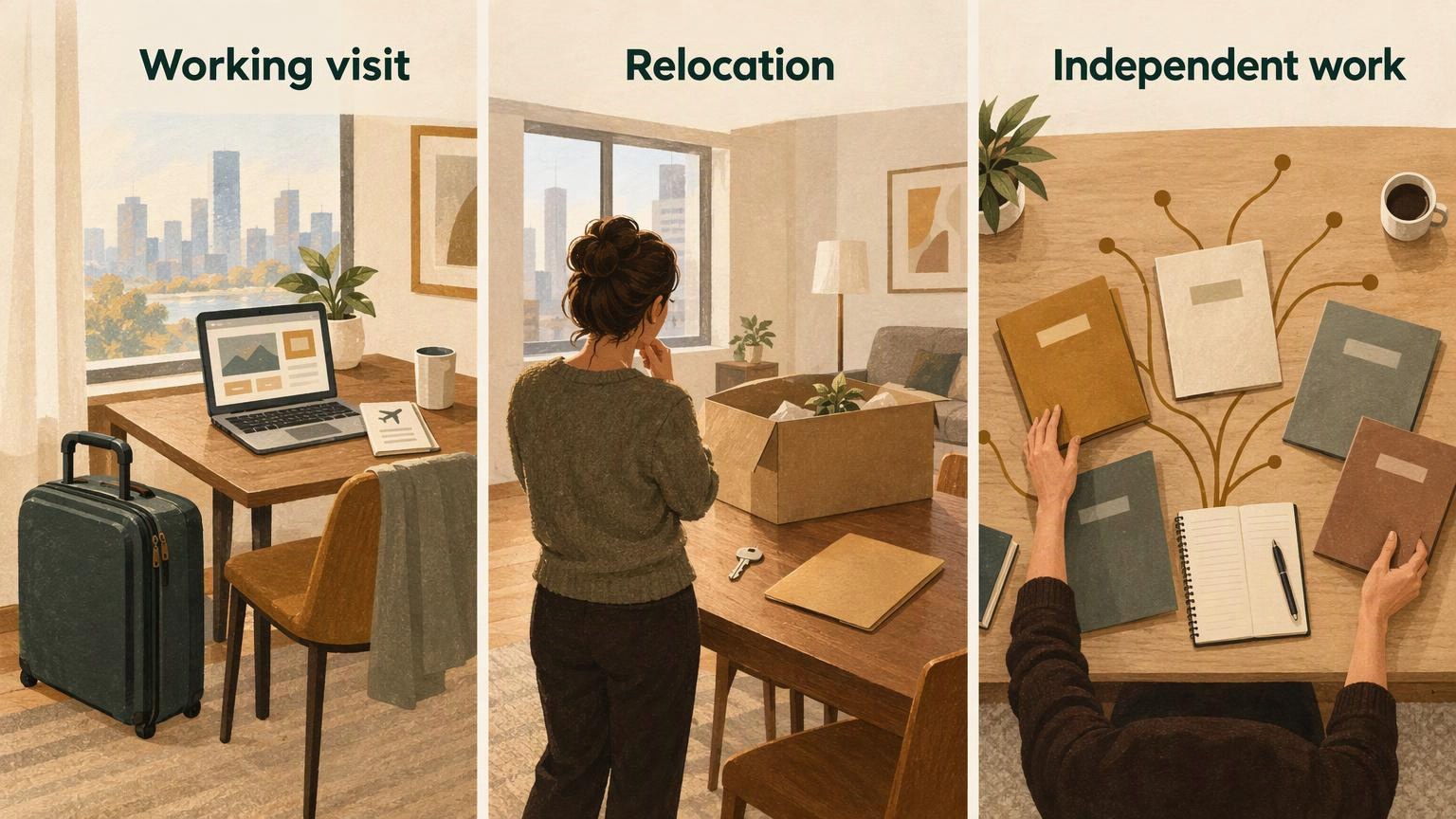
Illustration comparing “Working visit,” “Relocation” and “Independent work” through travel luggage, a moving box and key, and folders arranged around a notebook with branching lines.
Make the professional discussion concrete
A clear account of the proposed arrangement is more useful than asking several professionals the same broad question, "Can I move to Mexico?" Each professional needs enough detail to explain their part and its dependencies.
For immigration review, that account includes the purpose of the stay and actual activities. For tax review, it includes income types, work locations, travel history, homes, and U.S. ties; for employer review, it includes duties and the intended international arrangement.
The resulting explanation should make clear what it covers, which facts it depends on, and what would require another assessment if the plan changes. Current requirements and time-sensitive information need identifiable official references and a review date.
For instance, adding Mexican clients, changing from employment to independent work, or deciding to make Mexico your main home would change the description being assessed. An earlier answer should not be treated as covering a materially different plan.
This is also where roles need to stay clear. A destination guide helps compare living preferences; it does not determine work authorization or prepare a cross-border tax position. Qualified independent professionals remain responsible for the relevant professional advice.
Keep destination fit separate from legal and tax eligibility
The Golden Life provides destination and property guidance for Americans considering Mexico. Its process begins with your objective, then compares fit through priorities such as budget, timing, access, wellness, and community.
For a remote worker, the lifestyle question is concrete: what would an ordinary workday look like, and what would make living there worthwhile outside working hours? Workspace suitability, everyday errands, social connection, and the intended use of a home belong in that comparison.
The broader living and relocation planning framework provides context for deciding whether this is an exploratory stay or a move toward a different everyday life. It does not replace independent assessment of permission, taxes, or employer requirements.
For that destination-planning step, The Golden Life's Find your place lets you share your priorities and send an inquiry. The report is a planning resource, not an immigration approval, tax opinion, or promise of property availability.
You can learn which lifestyle priorities matter while professionals evaluate the working arrangement. Keeping those tracks separate allows a useful destination comparison without implying that every practical or professional question has already been settled.