
Where to live in Mexico: how to choose a setting

Choose where to live in Mexico by starting with the routines your setting must support: getting around, spending time outdoors, maintaining relationships, accessing necessary services, and managing everyday expenses. Separate essential needs from preferences, compare setting types, and test specific neighborhoods. A destination belongs on your shortlist when its practical arrangements fit your life, not because it ranks highly on someone else's list.
Table of Contents
- Start with the week you want to live
- Separate the landscape from the size of the community
- Test climate and accessibility separately
- Compare the cost of the routine, not only the home
- Choose a community through participation, not population
- Work through the choice before expanding your shortlist
- Use a visit to challenge your preferred setting
- Frequently Asked Questions
A beach, a historic center, and a quiet residential street can each look appealing while supporting very different daily lives. Deciding where to live in Mexico means distinguishing the landscape you enjoy from the arrangements you need.
For Americans considering retirement, relocation, or a second home, the useful question is what an ordinary week would involve. This framework connects that choice to planning to retire or relocate to Mexico, without ranking destinations or assuming a property purchase comes next. The goal is a shortlist you can explain, test, and revise.
Start with the week you want to live
Describe your regular activities before choosing a destination. Include grocery shopping, seeing friends, working if applicable, exercising, hobbies, and staying connected with family in the United States.
Then describe how you want those activities to happen. Walking to groceries is a different requirement from having a supermarket somewhere in the region; casual conversation on familiar streets is different from attending occasional organized events.
Give each preference a consequence. If you cannot comfortably drive, transportation is an essential condition. If you enjoy a sea view but would happily visit the waterfront occasionally, the view is a preference rather than a reason to reject an otherwise suitable neighborhood.
- Essential needs: arrangements whose absence would make everyday life impractical.
- Strong preferences: qualities that materially improve your routine but allow compromise.
- Extras: things you enjoy without needing them regularly.
Full-time and seasonal living also need different tests. A second home may support a limited set of activities during your intended visits, while a full-time home must work through the less appealing parts of the year as well.
For a couple, complete this exercise separately before combining it. A shared shortlist should preserve each person's essential needs rather than average them into preferences neither person recognizes.
Separate the landscape from the size of the community
Coast, desert, mountains, and lakes describe surroundings. City, small town, and rural area describe settlement patterns. Neither tells you, by itself, how easily you can complete errands or build a social routine.
A coastal address could sit in a busy urban neighborhood or an isolated residential area. A small-town address could put daily needs within reach or require transportation for nearly everything. Compare the actual arrangement rather than the label.
The table below describes choices to investigate, not promises about every Mexican community.
| Setting | Reason to investigate | Trade-off to examine | Useful test |
|---|---|---|---|
| Urban neighborhood | Daily errands and activities may share a compact area. | Street activity, noise, traffic, and building access may affect comfort. | Complete errands and return home at the times you would normally travel. |
| Small town | A familiar local routine may matter more than a wide selection of activities. | Some services or social options may require travel elsewhere. | Identify which needs the town itself can meet and which require another journey. |
| Planned residential community | The physical layout and shared amenities may suit your preferred routine. | The community's internal convenience may not extend to outside errands. | Compare life inside the community with the trips needed beyond it. |
| Rural or low-density area | Space and privacy may be central to your preferences. | Transport, utilities, maintenance, and social contact need closer examination. | Work through an ordinary week without treating every outing as a special trip. |
What makes a small town a good fit?
Searching for the best small towns in Mexico to live in is more useful once you know what you mean by small-town life. You might want recognizable faces and a central meeting place, or you might mainly want a quiet home with few immediate neighbors.
Those are different searches. A town center may meet the first preference while frustrating the second, so define the experience before collecting place names.
| Setting | Potential appeal | Trade-off | Useful test |
|---|---|---|---|
| Urban neighborhood | Compact errands and activities | Noise, traffic and building access | Run errands at your usual travel times |
| Small town | A familiar local routine | Some services may require travel | Identify needs met locally vs. elsewhere |
| Planned residential community | Layout and shared amenities | Outside errands may be less convenient | Compare internal life with outside trips |
| Rural or low-density area | Space and privacy | Transport, utilities and maintenance | Work through an ordinary week |
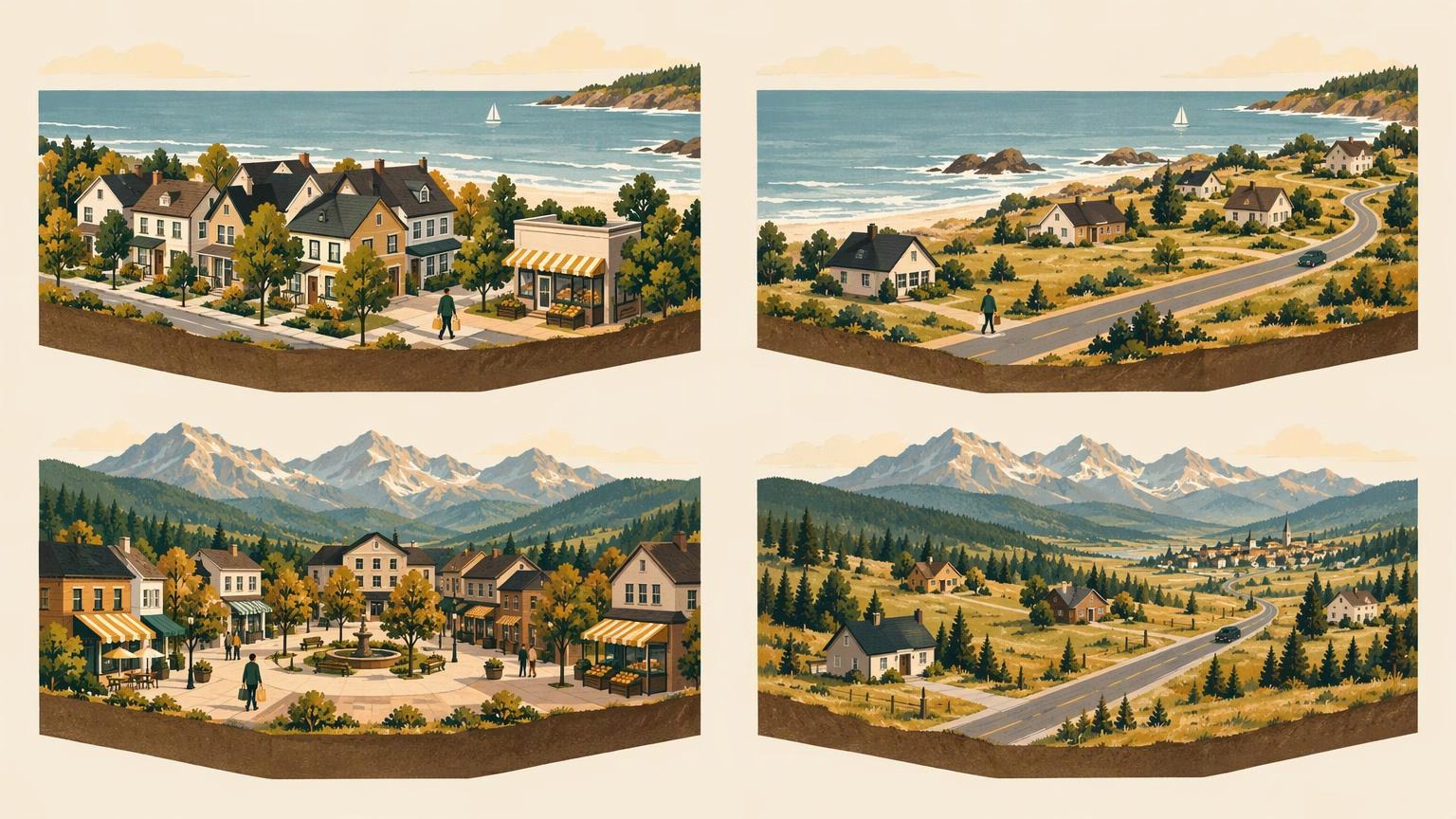
Illustration contrasts compact coastal and mountain neighborhoods with dispersed homes in matching landscapes, using shops, a plaza and roads to show different settlement patterns.
Test climate and accessibility separately
A setting can suit your preferred weather yet make daily movement difficult. It can also have an appealing layout that you rarely use because outdoor conditions are uncomfortable for you. Keep these decisions separate so strength in one does not hide a problem in the other.
Evaluate the months you would actually live there
Mexico is not a single climate choice. Your comparison should distinguish heat, humidity, cooler conditions, and seasonal variation, then connect them to your intended activities.
Ask whether you would enjoy being outside when you normally walk, exercise, or meet friends. Also consider the indoor routine: ventilation, cooling needs, usable outdoor space, and whether closing windows would change your experience of the home.
A pleasant holiday establishes how a place felt during that visit. It does not establish year-round comfort. Use current local weather information for the months you expect to stay, and treat another person's description of comfortable weather as a personal preference rather than a standard.
Follow the route beyond the front door
Accessibility includes the building, the street, and the whole journey to your destination. An elevator does not resolve an awkward entrance, and a central location does not establish a comfortable walking route.
Inspect surfaces, slopes, crossings, steps, shade, and places to pause. Test the route with the tasks you actually perform, such as carrying groceries, rather than only taking a leisurely walk.
Airport access deserves the same address-level treatment. Compare the complete journey, current schedules, connections, and ground transportation for your likely travel days; a regional description of international access is only a starting point.
If medical needs influence accessibility or travel, an appropriately qualified independent medical professional should help evaluate those needs. Lifestyle observations cannot establish that a setting is medically suitable.

Illustration of a grocery journey from a stepped doorway to a shop, with a gold route line, paving-detail insets, tree shade, a bench and a sunlit crossing.
Compare the cost of the routine, not only the home
A housing figure cannot tell you whether a setting fits your budget. The relevant comparison includes the expenses created by living at that address in the way you intend.
Consider utilities, transportation, groceries, communications, upkeep, community charges where applicable, and travel to maintain important relationships. Keep moving expenses and initial setup separate from recurring costs so they do not disappear inside a monthly estimate.
Compare equivalent routines. A car-dependent home and a home where you can complete everyday errands on foot are different financial arrangements, even before comparing their housing costs.
Likewise, a seasonal home and a full-time residence should not be evaluated using identical assumptions. A property left unoccupied raises different practical questions about oversight and maintenance, while frequent visits add travel expenses to the living plan.
Use current, dated local quotes for the items that matter to your shortlist. Mark which figures are quotes, which are your own spending assumptions, and which still require investigation.
If financing would determine whether a purchase is feasible, keep that question outside the lifestyle comparison. Financing may be available for qualified U.S. buyers through licensed providers; eligibility, property requirements, underwriting, rates, terms, fees, and approval apply.
Qualified independent financial professionals can help assess personal affordability. An attractive destination does not establish financing approval or make a property an appropriate investment.
Choose a community through participation, not population
An established international community may be a useful starting point, but its presence does not tell you whether you will enjoy its activities or make lasting connections. Look for ways you would participate regularly.
Someone who enjoys scheduled clubs may value a different social setting from someone who prefers spontaneous conversation in a familiar neighborhood. Neither needs the largest community; each needs accessible opportunities that fit their habits.
Language is part of this comparison. Consider the situations you need to navigate independently and the time you want to spend learning Spanish, without assuming that international residents mean English is available everywhere.
It is also useful to distinguish meeting people from belonging somewhere. A busy visitor-oriented area may provide plenty of introductions, while your preference may be relationships that continue beyond a season.
During a visit, attend an activity you would genuinely repeat. Notice who participates, how people join, and whether getting there fits your ordinary week.
Community and wellness belong here as lifestyle themes: movement you enjoy, social contact, and activities with personal meaning. They are not evidence that any destination will improve health or longevity.
Work through the choice before expanding your shortlist
Say you want coastal living, regular social contact, and everyday city services. You enjoy golf on vacation, but you would rather spend most weeks exploring a neighborhood and meeting people without planning each outing around a leisure facility.
Puerto Vallarta's mountain-framed bay, established international community, neighborhood character, and everyday city services make it a reasonable starting point for that search. Those details connect to the routine you described, although an individual address still needs testing.
Los Cabos presents a different starting point: desert landscape meeting the Sea of Cortez, with marina life, golf, and polished amenities. It deserves consideration if those activities would anchor your regular life rather than remain occasional holiday interests.
For this reader, the next comparison would focus on residential neighborhoods in Puerto Vallarta because neighborhood life and services carry more weight than golf. That is a direction for investigation, not a declaration that every address there is suitable or that Los Cabos is inferior.
Now change the priorities. If marina life and golf become central to how you want to spend your time, Los Cabos becomes a stronger candidate. The decision changes because the routine changes, not because either destination has moved up a ranking.
The Golden Life connects destination and property direction to budget, timing, access, wellness, and community priorities. Its Find your place lets you share your priorities and send an inquiry.
Turn your priorities into a direction worth investigating.
Use a visit to challenge your preferred setting
A useful visit tests the reason a place made your shortlist. If the appeal is walking, walk the actual errands; if it is community, participate in something you would attend regularly.
Spend time around potential residential streets at different points in your intended routine. Observe noise, traffic, construction, deliveries, and how comfortable you feel moving between the home and daily destinations.
Separate what you experienced from what someone told you. A completed grocery trip is an observation; a promise that transport is always easy needs further checking.
Record evidence against your favorite choice as carefully as evidence for it. A setting may remain appealing while revealing a compromise you do not want to make, such as dependence on driving or a social calendar that does not suit you.
Keep questions requiring professional assessment in a separate workstream. Healthcare and insurance suitability require qualified guidance, while property, legal, tax, immigration, technical, and financial matters require appropriately qualified independent professionals.
A destination comparison should end with a reasoned direction: this setting supports these routines, creates these trade-offs, and leaves these material questions to verify. That is enough to guide the next stage without turning an exploratory visit into a purchase commitment.