
Property taxes in Mexico: what belongs in your yearly ownership budget?

Property taxes in Mexico, commonly called predial, belong in a yearly budget alongside any condominium fees, utilities, maintenance, management, insurance, and applicable ownership-structure charges. There is no single nationwide figure that establishes what a particular home will cost to own. A qualified independent local tax professional can verify the municipal calculation, while current property documents and service quotes establish the remaining expenses.
Table of Contents
- Understand the municipal tax figure before comparing homes
- Separate recurring expenses from the money needed to buy
- Which property type puts maintenance responsibility where you want it?
- An empty second home still needs a management plan
- Treat insurance as a separate coverage decision
- Build an annual total that compares like with like
- Work through the choice: a seasonal second home
- Frequently Asked Questions
A small tax bill can draw your attention, but it does not describe the whole financial commitment. A condominium with shared amenities, a house you maintain directly, and a second home left empty between visits can create very different recurring obligations.
When comparing property taxes in Mexico, the useful question is how the complete yearly cost fits the way you intend to live. The Golden Life's second-home and investment planning hub provides broader context for that decision. This article focuses on recurring ownership expenses, not purchase prices or closing-cost estimates. It is general educational information, not tax, legal, insurance, financing, or investment advice.
Understand the municipal tax figure before comparing homes
Predial is the term you will encounter for the municipal property-tax charge. For a particular purchase, the municipality's current information and a qualified independent tax professional are the appropriate basis for understanding the amount and payment obligations.
A quoted percentage is incomplete without its calculation basis. The asking price, a valuation used for municipal purposes, and the amount shown on a previous bill are different pieces of information; a local professional can explain which applies to the property under review.
This matters when someone describes a home as inexpensive to own because of its tax bill. The figure may refer to an earlier year, a different property, or a payment made under terms that do not apply to the next owner.
The sources available for this article do not establish dated, municipality-specific annual cost ranges, so no numerical comparison between municipalities is presented. A supported municipal tax comparison requires current official municipal evidence identifying the municipality, tax year, applicable property category, and valuation basis, together with the source and review date. Undated nationwide figures cannot fill that gap. Other ownership expenses remain unpriced here because supported, dated amounts are not available.
A useful municipality-level annual range includes those details. Without them, a range does not establish a dependable comparison between locations or show what a particular home will cost to own.
For a specific home, a current municipal bill gives the discussion a concrete starting point. Questions about unpaid amounts, payment status, deadlines, discounts, or a change in ownership belong with the municipality and qualified independent legal and tax professionals, rather than a nationwide estimate.
Separate recurring expenses from the money needed to buy
A yearly ownership budget describes the cost of holding and using the property after purchase. Acquisition expenses belong in a separate calculation, so the annual total does not mix a one-time transaction with ongoing obligations.
The distinction is especially useful when a quotation bundles several services. An initial setup charge and a recurring administration charge may appear together, but they have different effects on later years.
Recurring commitments
Depending on the property and its documents, recurring commitments may include municipal tax, condominium charges, service subscriptions, management, and applicable ownership-structure administration. Insurance belongs here at the amount and payment frequency established by the policy.
These expenses form the starting point of the annual budget. Some may remain payable during periods when nobody uses the home.
Expenses that follow use
Utilities, cleaning, and wear-related maintenance need a separate allowance based on intended use. A seller's bills reflect the seller's occupancy habits, which may differ from yours.
For rental use, guest turnover and management services can add operating expenses. Possible rental income belongs in a separate analysis and is not guaranteed.
Irregular repairs and shared projects
A budget that includes only routine bills can miss equipment replacement, repairs, or a shared-building project. A qualified independent technical professional can assess physical conditions, while the building's records help explain planned work.
Keeping an allowance for irregular spending separate makes the comparison clearer. It distinguishes a predictable service charge from money that may be needed for a repair whose timing is uncertain.
Which property type puts maintenance responsibility where you want it?
The meaningful difference is often who organizes maintenance and how you pay for it. A shared-building charge can fund work you would otherwise arrange directly, so comparing fees alone can be misleading.
A simple condominium, an amenity-heavy condominium, and a detached house create different questions about recurring spending. The documents and physical condition of each property determine the actual obligations.
| Property choice | Expenses to examine | Responsibility to examine | Main trade-off |
|---|---|---|---|
| Condominium with limited shared amenities | Regular shared charges and unit-level maintenance | Which work belongs to the owner versus the association | Less shared equipment to evaluate, but individual-unit expenses still matter |
| Condominium with extensive shared amenities | Operating budget, maintenance charges, reserves, and planned projects | How shared facilities are funded and administered | Convenience and amenities can bring a larger continuing shared commitment |
| Detached house | Direct maintenance, equipment servicing, grounds care, and repairs | Who arranges access, inspections, and work | More direct control can mean more coordination and uneven repair spending |
| Property type | Costs to review | Who handles work? |
|---|---|---|
| Limited-amenity condo | Shared charges and unit maintenance | Check owner vs. association duties |
| Extensive-amenity condo | Shared operations, reserves, projects | Check how shared facilities are managed |
| Detached house | Maintenance, grounds care, repairs | Owner arranges access, inspections, work |
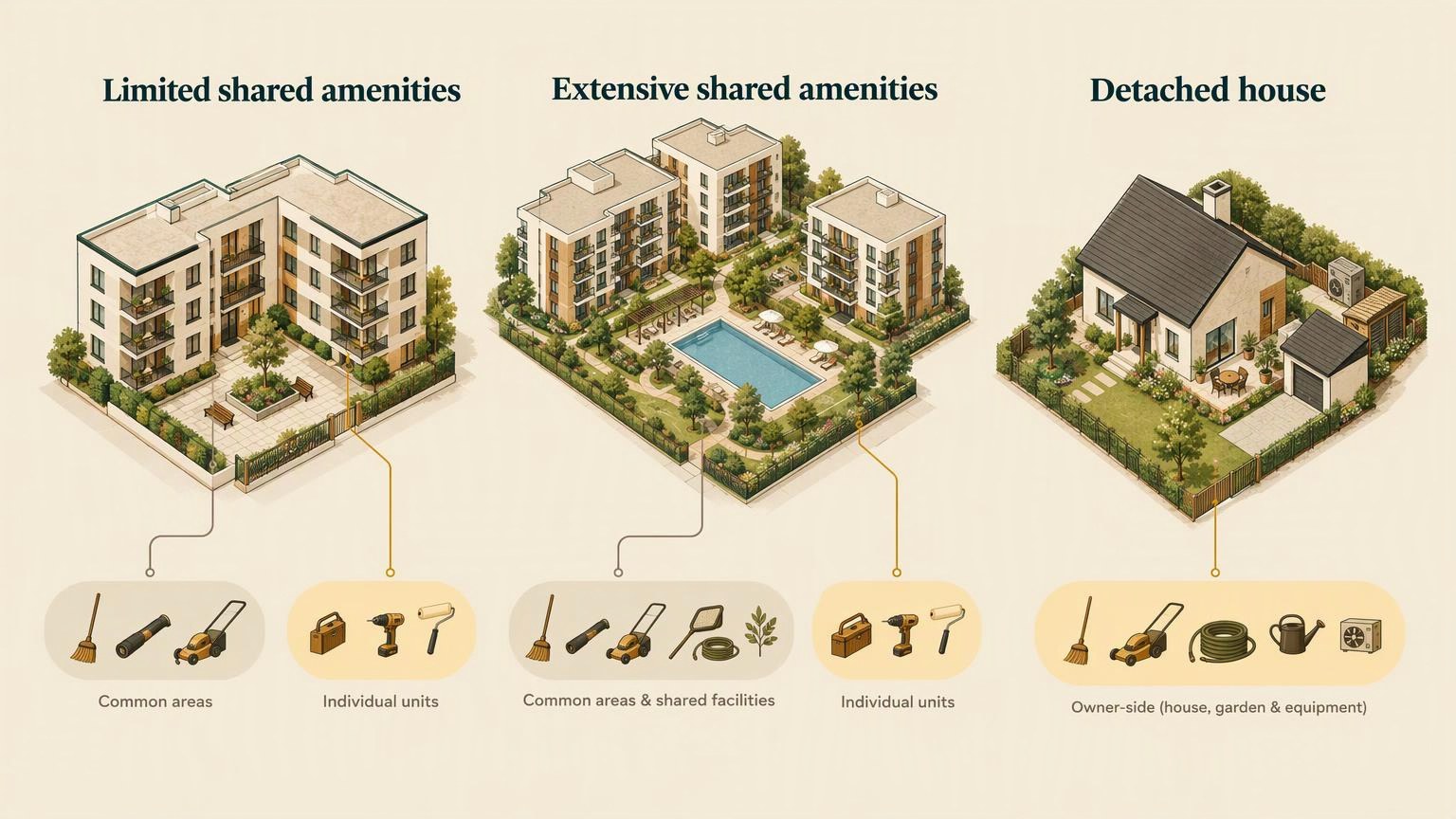
Illustration of two condominium settings and a detached house, with connecting lines and tool groups distinguishing common-area, individual-unit and owner-side maintenance.
An empty second home still needs a management plan
Time away changes the ownership workload. Even without guests, someone may need to inspect the property, coordinate maintenance, arrange access, and handle communications about bills or shared-building matters.
Property management in Mexico can involve different service scopes. A home-care arrangement and a rental-management arrangement should not be treated as interchangeable simply because both use the word management.
Home care concerns the property while you are absent. Rental management may also involve guest communications, cleaning coordination, turnover, and rental administration, depending on the contract.
A comparison becomes more useful when the service scope is translated into responsibilities. Who receives a repair request? Who can authorize work? Which visits are included, and which tasks create separate charges?
The trade-off is ordinary but important: handling arrangements yourself can reduce purchased services, while also leaving you with the work and coordination. Paying for management shifts some of that workload, but the contract determines how much.
Distance from the home does not by itself establish that you need a particular provider. What changes the decision is whether there is a dependable, documented way to handle the tasks that continue while you are away.

Illustration of a traveler with a suitcase beside a doorway, with window inspection, toolbox and key, and envelope and folder vignettes linked to an unoccupied house cutaway.
Treat insurance as a separate coverage decision
The cost of homeowners insurance in Mexico cannot be evaluated responsibly from a premium alone. A qualified independent insurance professional can explain the policy terms for the property, its location, and its intended use.
Coverage questions include what property is insured, what events or losses are excluded, and how deductibles and limits apply. A lower quotation is not a like-for-like comparison if the underlying coverage differs.
For a condominium, the relationship between any shared-building policy and an individual owner's policy needs professional review. The existence of a building policy is not enough to establish what is covered inside a particular unit.
Occupancy also belongs in that conversation. Personal use, periods of vacancy, and rental use should be described accurately so a qualified professional can explain the relevant terms.
In the annual budget, the premium is a scheduled expense. Deductibles and uninsured losses are different exposures, not amounts to fold into the premium as though they were included benefits.
This article does not establish coverage, eligibility, or a required policy for any home. Current policy documents and appropriately qualified insurance advice are necessary for those decisions.
Build an annual total that compares like with like
A useful annual total combines recurring commitments, expenses tied to use, and a separate allowance for irregular work. Keeping those parts visible prevents an attractive headline figure from concealing a different workload or exposure.
Start with each expense in the currency in which it is billed. If the household budget is in U.S. dollars, show the conversion separately with its date and exchange-rate assumption rather than presenting an undated dollar equivalent.
Payment frequency matters too. A monthly service charge, an annual policy premium, and a repair quotation should all be labeled before they are placed in the same comparison.
For each amount, a useful budget record contains the document or provider name, document date, period covered, currency, and whether the amount is an actual bill or an estimate. This gives a qualified professional or buyer a way to understand the total without rebuilding it from memory.
A lower and upper annual estimate can reflect different occupancy assumptions or separately quoted service choices. Neither estimate is a spending limit, and an unpriced repair should not quietly become a zero.
If financing is part of the purchase, financing may be available for qualified U.S. buyers through licensed providers. Eligibility, property requirements, underwriting, rates, terms, fees, and approval apply; financing obligations need their own documented review rather than assumptions based on the property price.
For a comparison with a U.S. home, use equivalent categories and intended use. Comparing a complete U.S. ownership budget with only a Mexican municipal tax bill would answer the wrong question.
Work through the choice: a seasonal second home
Say you want a second home for personal visits and expect to leave it empty between stays. Shared amenities appeal to you, but keeping the ongoing workload manageable matters more than having extensive facilities.
A condominium with limited shared amenities may fit that preference if its charges fund the work you want handled collectively. An amenity-heavy condominium may still be worthwhile, but only if you expect to use those facilities enough to accept their continuing shared costs.
A detached house gives you more direct control over maintenance arrangements. That can suit someone who enjoys organizing the work, but it creates a different responsibility during absences; the comparison needs to include any home-care services you would purchase.
The municipal tax bill does not settle this choice. The deciding evidence is the combination of documented shared charges, direct maintenance needs, and the arrangements for care between visits.
For this reader, the limited-amenity condominium is the stronger starting point because it aligns with the stated preference for shared maintenance without extensive facilities. That is a starting preference, not a recommendation to buy: the building's condition, records, and actual costs could change the result.
The Golden Life begins with intended use and lifestyle priorities, then connects them to destination and property direction. Its Find your place lets you share your priorities and send an inquiry.