
Moving to Mexico: menaje de casa, shipping, and bringing a car

Plan a move to Mexico as separate household-goods, transportation, and vehicle decisions. Menaje de casa concerns household belongings and their customs treatment; it is not a moving service or a substitute for vehicle documentation. Compare what is worth shipping with what your new home actually needs, then have qualified independent professionals explain the current requirements before you commit to transport.
Table of Contents
- Separate menaje de casa from the moving service
- Which belongings are worth moving?
- Choose a shipping approach by responsibility, not box count
- Build an inventory that survives every handoff
- Compare the full moving cost and delivery scope
- Evaluate bringing a car as a separate project
- Work through a move before committing to the load
- Frequently Asked Questions
A sofa, a collection of family photographs, and a car create different moving decisions. The sofa needs to fit the home and justify its shipping cost; the photographs may be worth keeping regardless of replacement value; the car needs its own evaluation.
For Americans planning menaje de casa in Mexico, the useful starting point is the household you intend to establish, not everything currently in storage. The Golden Life's broader retirement and relocation guidance connects that move to everyday life. Here, the focus is the physical move: possessions, transport responsibilities, delivery, and the separate car question.
Separate menaje de casa from the moving service
Menaje de casa refers to household goods. In relocation planning, the term also appears in discussions of the documentation and customs treatment associated with bringing those belongings into Mexico. That customs question is different from hiring someone to pack, transport, or deliver them.
A useful distinction is between a consular or customs document, a transport agreement, and a vehicle document. Each answers a different question: how the goods are treated, who moves them, and how the vehicle is handled.
Calling a shipment a household move does not establish that everything inside receives the same treatment. Nor does a moving quote establish a person's eligibility for a particular customs procedure. Qualified independent customs and immigration professionals can explain how current requirements relate to the proposed move.
This article is general educational information, not legal, tax, immigration, customs, or insurance advice. Eligibility, document requirements, and timing belong in a current, case-specific professional review.
Why this distinction changes your planning
Keep the transport plan and the customs review connected without treating them as interchangeable. A truck may be available before the documentation is ready, while completed paperwork does not tell you whether the shipment includes unloading at the destination.
The practical goal is a shipment whose contents, proposed customs handling, and contracted services describe the same move. A change in the contents or delivery plan is a reason to revisit the relevant documents before dispatch.
Customs documentation and transport are separate questions from where you want to live.
Which belongings are worth moving?
Start with the destination home. Its furnishing inventory, room dimensions, storage space, and delivery access determine whether your existing furniture has a useful place there.
For moving furniture to Mexico, compare the item's role in your new life with its total transport burden. That burden includes packing, handling, possible storage, and the work of arranging delivery, not merely the linehaul charge.
A familiar chair may matter because you use it every day. A large cabinet may have little practical value if the home already has sufficient storage. Sentimental value is a legitimate reason to keep something, but it does not make the object easier to move.
Separate emotional value from replacement value
Sort belongings into those you cannot meaningfully replace and those you can evaluate against alternatives. Family keepsakes belong in the first group; ordinary furniture often belongs in the second, although your priorities may differ.
For replaceable items, compare a written shipping estimate with actual replacement options at the destination. Do not assume that local replacements will be cheaper or immediately available. For appliances, physical dimensions and technical compatibility deserve their own evaluation.
Account for the cost of waiting
A home can be ready for you before a shipment is ready for delivery. Identify the essentials you would need during that gap and whether the home already supplies them.
Keeping furniture in storage preserves options, but it adds an ongoing expense and a later transport decision. Selling or donating simplifies the move, but it may mean giving up an item you will want again. Neither choice is universally better.
What is worth moving depends on the home and everyday life you are planning for.
Choose a shipping approach by responsibility, not box count
Shipping household goods to Mexico can involve a coordinated household move, a smaller freight or parcel shipment, or a self-managed load. The important difference is who handles each handoff and who resolves a problem when transport and customs questions intersect.
A small shipment with unclear handling can demand more attention than a large shipment with a well-defined service agreement. Compare the work you retain, not simply the amount you are moving.
| Approach | When it merits comparison | Work you may retain | Main trade-off |
|---|---|---|---|
| Coordinated household move | Furniture and belongings need linked packing and delivery services | Inventory decisions, document review, and confirming the service scope | Convenience depends on what the written agreement actually includes |
| Freight or parcel shipment | A limited set of belongings can be packed for the chosen transport service | Packing, clearance arrangements, and destination handoffs unless included | A transport service may leave other parts of the move to you |
| Self-managed load | You want to retain control of packing and transport | Loading, travel, unloading, and coordination with qualified professionals | More control also means more personal responsibility |
Can a regular carrier handle the shipment?
That depends on the carrier's actual service and the proposed customs handling. Acceptance of a box for transport is different from an agreement to process it as part of a household relocation.
Describe the shipment before requesting a quote: used household belongings, furniture, fragile pieces, and any items requiring separate review. Obtain a written explanation of who handles clearance, what documents the service expects, and where its responsibility ends. Do not assume every carrier provides the same service.
| Approach | Work you retain | Main trade-off |
|---|---|---|
| Coordinated household move | Inventory, document review, scope checks | Convenience depends on written scope |
| Freight or parcel shipment | Packing, clearance, handoffs if excluded | Transport may leave other work to you |
| Self-managed load | Loading, travel, unloading, coordination | More control, more responsibility |
Build an inventory that survives every handoff
A working inventory connects your packing decisions to the quote and the eventual delivery. It is a logistical record, not a substitute for the official inventory format or other documents a qualified professional identifies for your shipment.
Use clear item descriptions and matching box labels. For a boxed set of kitchen items, record what the box contains; for a distinct appliance or piece of furniture, record identifying details and condition. Photographs provide a useful companion record.
- Give each box or large item a unique identifier.
- Record the contents and note fragile components.
- Keep identifying details for items that have them.
- Record whether an item is new or used without treating that distinction as proof of eligibility.
- Keep a copy accessible outside the shipment.
Ask the responsible professional how this working inventory should be translated or adapted for the applicable documentation. Your private packing list and the official submission may have different purposes.
Keep items needing separate review visible
Do not hide a difficult item inside a broad description such as personal effects. Food, plants, medicines, chemicals, and other unusual contents deserve explicit review rather than an assumption that household use makes them acceptable.
This is not a list of prohibited goods. Current official classifications and any required permissions need independent verification. Identifying questionable contents early gives the reviewer something specific to assess and avoids rebuilding the inventory after packing.
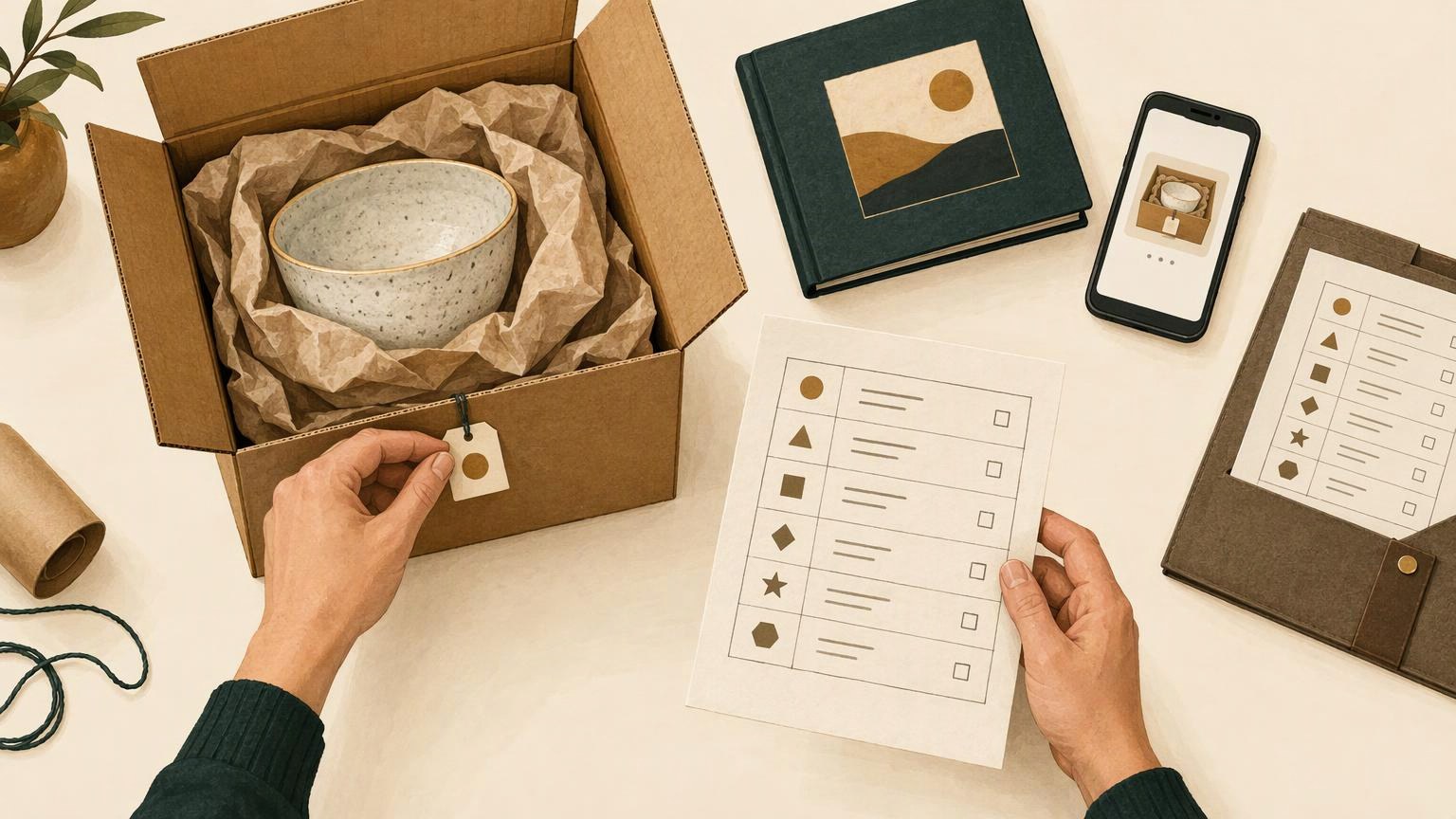
Packing illustration with a circle-tagged box, a bowl cushioned in paper, matching shape-based inventory sheets, a closed album and a phone showing the boxed bowl.
Compare the full moving cost and delivery scope
A useful quote describes both the price and the work behind it. Estimates are easier to compare when they use the same inventory, collection address, delivery address, and packing assumptions.
Separate the transport charge from services or expenses that may be additional. Depending on the agreement, these can include packing, clearance coordination, inspection handling, storage, unloading, or access-related charges. A qualified professional can explain applicable customs costs; the transporter can explain its own charges.
For household budgeting, compare the complete quoted move with the alternatives: replacement purchases, temporary essentials, retained storage, and disposal of items left behind. A low transport estimate can still produce an expensive overall plan if it omits work you need.
Understand what door-to-door means in the contract
Identify the physical delivery point. Delivery to an entrance, unloading inside the home, placing furniture in rooms, and unpacking are different tasks. The phrase door-to-door alone does not tell you which tasks are included.
Share practical access details with the transporter, including stairs, elevators, loading restrictions, or vehicle access where relevant. Confirm those details with the actual building or homeowner rather than relying on assumptions about the neighborhood.
Plan for a changed arrival
Clarify how the agreement handles a shipment that cannot be delivered as planned. Relevant details include where it can be held, who authorizes storage, how charges are calculated, and who remains your point of contact.
For damage or loss protection, obtain the applicable written terms and consult a qualified independent insurance professional as needed. Coverage, exclusions, declared values, and claims requirements should not be inferred from the fact that the shipment is professionally transported.
Evaluate bringing a car as a separate project
Whether importing a car to Mexico is possible for a particular move needs its own assessment. The fact that a vehicle carries household goods does not answer the vehicle's documentation, eligibility, or ongoing-use questions.
Distinguish bringing a vehicle for a limited period from seeking to keep it in Mexico long term. Temporary and permanent import concepts should not be treated as interchangeable. Their current application to your vehicle and circumstances belongs with qualified independent customs, immigration, and legal professionals.
Prepare a vehicle file for that discussion: ownership documents, identifying details, any financing or lease agreement, and the intended use. A professional can explain which details matter and whether further documentation is necessary.
Compare keeping the car with arranging transport after arrival
Evaluate the practical benefit of the car separately from the convenience of carrying belongings in it. Consider the routines it would support, parking at the intended home, maintenance options, and the burden of transporting it.
Compare that plan with destination transportation options using current local information. A familiar vehicle may be useful; it may also create an additional project when the household move is already demanding. Do not assume that selling and replacing it will be cheaper without actual figures.
Treat permit closure as part of the planning question
If a temporary vehicle permit is relevant, have a qualified professional explain its duration, conditions, and cancellation or closure process before relying on that route. Keep the resulting records accessible and separate from the household inventory.
Consequences of leaving a permit open require current official guidance and a case-specific assessment. A household shipment's completion or a personal departure should not be treated as proof that all vehicle obligations have been settled.
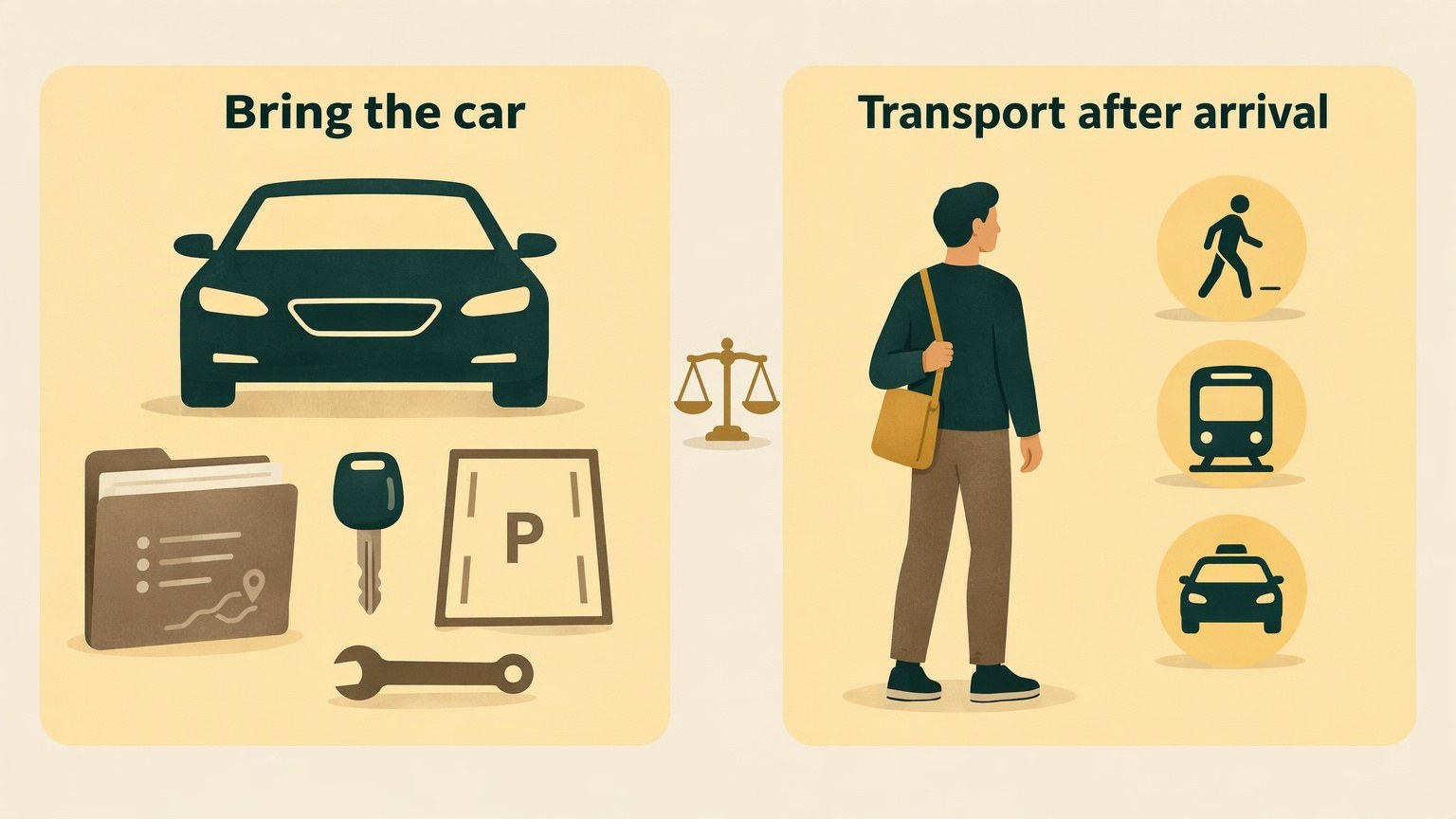
Illustration comparing “Bring the car” with “Transport after arrival,” using vehicle-planning objects, a traveler and transportation icons, with level scales between the panels.
Work through a move before committing to the load
Say you are moving into a furnished home in Puerto Vallarta and want to bring family keepsakes, a favorite desk, and your existing car. Puerto Vallarta has an established international community, neighborhood character, and everyday city services, but those destination qualities do not establish what your particular home includes or how you will travel between errands.
Start with the furnishing inventory and the desk's dimensions. If the home already has a suitable workspace, shipping the desk mainly preserves a personal preference. If it fills a genuine need and fits the room, a transport quote becomes more useful.
The keepsakes have a different value. Compare transport approaches for that selected load rather than automatically quoting the entire former household. Review their contents and proposed customs handling with the relevant independent professional.
Then evaluate the car against the trips you expect to make and the current professional assessment of bringing it. Using the car to carry the desk does not, by itself, make bringing the vehicle the better choice.
The choice follows from the dependencies: confirm the home's needs, define the goods worth keeping, compare transport responsibilities, and evaluate the vehicle independently. You can reach different conclusions for the desk, the keepsakes, and the car without making the plan inconsistent.
If the destination or type of home is still being refined, The Golden Life's Find your place lets you share your priorities and send an inquiry. That supports destination and property direction, not customs clearance or vehicle approval.