
Where should you retire abroad: Mexico, Costa Rica, Panama or Portugal?

Mexico, Costa Rica, Panama and Portugal suit different retirement priorities; none is the universal winner. Mexico has varied coastal settings, Costa Rica brings a tropical nature focus, Panama presents city and highland alternatives, and Portugal appeals to people seeking a European setting with seasons. Compare specific communities using the same budget, travel, healthcare, residency and daily-life criteria before deciding which country deserves a closer look.
Table of Contents
- What kind of retirement does each country suggest?
- How do you compare retirement costs fairly?
- Which questions need separate professional review?
- Can the place support your relationships and daily routine?
- How would the comparison change for a real retirement plan?
- Should the property decision wait until the destination fits?
- Where does The Golden Life fit if Mexico remains a candidate?
- Frequently Asked Questions
Start with the life you want, then test whether a particular community can support it. It is general educational information, not legal, tax, immigration, financial, medical or investment advice.
What kind of retirement does each country suggest?
Use the country as a starting point, not as the final unit of comparison. A coastal community and an inland city can produce very different lives within the same border.
The table uses the same lifestyle, access and daily-life questions for each country. These are directions for exploration, not ratings of affordability, medical care or suitability.
| Country | Lifestyle starting point | Access test | Daily-life test | Main trade-off to explore |
|---|---|---|---|---|
| Mexico | Caribbean coastline, Pacific bay communities or desert-and-sea settings | Whether the actual route supports your family travel | Whether the neighborhood works beyond vacation activities | A broad choice of settings requires a more focused local comparison |
| Costa Rica | Tropical beaches and rainforest-oriented living | Whether the route to your chosen community is practical | Whether outdoor appeal fits your ordinary errands and social life | A nature-first preference still needs an everyday service plan |
| Panama | Panama City high-rise living or Boquete's coffee-country setting | Whether your chosen city or highland base supports your travel pattern | Whether you prefer an urban routine or a highland community | City conveniences and a quieter setting answer different needs |
| Portugal | A European setting with Mediterranean seasons | Whether the travel pattern supports the relationships you want to maintain | Whether seasonal life matches your preferred routine | A European lifestyle goal may outweigh a tropical-climate preference |
Mexico is several lifestyle choices, not one
Riviera Maya combines Caribbean coastline, growing residential communities and international access. Los Cabos, in Baja California Sur, pairs desert landscape with the Sea of Cortez, marina life, golf and polished amenities.
Puerto Vallarta has a mountain-framed bay, an established international community, neighborhood character and everyday city services. These distinctions matter: someone seeking city routines and community may evaluate a bay neighborhood differently from someone whose days center on a marina.
Mexico's variety is an advantage only after you decide what you want. Otherwise, an appealing property can pull the search toward a lifestyle you never intended to choose.
The alternatives deserve their own terms
Costa Rica's tropical beaches and rainforest appeal should not be treated as interchangeable with Portugal's seasons. Panama City and Boquete also represent different retirement ideas rather than a single national experience.
Give each alternative a fair test. If the European setting is central to your retirement plans, Portugal may remain the stronger lifestyle candidate even when Mexico has settings you enjoy visiting.
| Country | Lifestyle | Daily-life test |
|---|---|---|
| Mexico | Caribbean, Pacific bay or desert-and-sea | Does life work beyond vacation activities? |
| Costa Rica | Tropical beaches and rainforest | Does nature fit errands and social life? |
| Panama | City high-rise or coffee-country living | Urban routine or highland community? |
| Portugal | European setting with seasons | Do seasons match your preferred routine? |
How do you compare retirement costs fairly?
A useful cost comparison prices the same life in each country. Comparing a small inland rental in one destination with a furnished waterfront home in another measures housing preferences more than national affordability.
Define the housing standard first: size, furnishing, accessibility, location and whether you expect to drive. Keep those assumptions consistent across Mexico, Costa Rica, Panama and Portugal.
- Housing: rent or ownership expenses, utilities, maintenance and any building charges.
- Daily spending: groceries, dining, transportation, communications and household services.
- Personal needs: healthcare and insurance costs assessed with qualified professionals.
- Connection to home: family visits, return travel and any expenses retained in the United States.
- Transition costs: moving, temporary accommodation, documentation and overlapping households.
Separate recurring expenses from the cost of getting established. A budget that works after the move may still leave too little room for the transition or an unexpected return trip.
Also distinguish an appealing advertised amount from a current, complete cost. Use dated local quotes with clearly stated inclusions, and compare them in a consistent currency. A qualified financial professional can help evaluate exchange-rate exposure and how spending relates to your retirement income.
The result need not identify the cheapest country. It should show which specific place supports your preferred life without depending on optimistic assumptions.
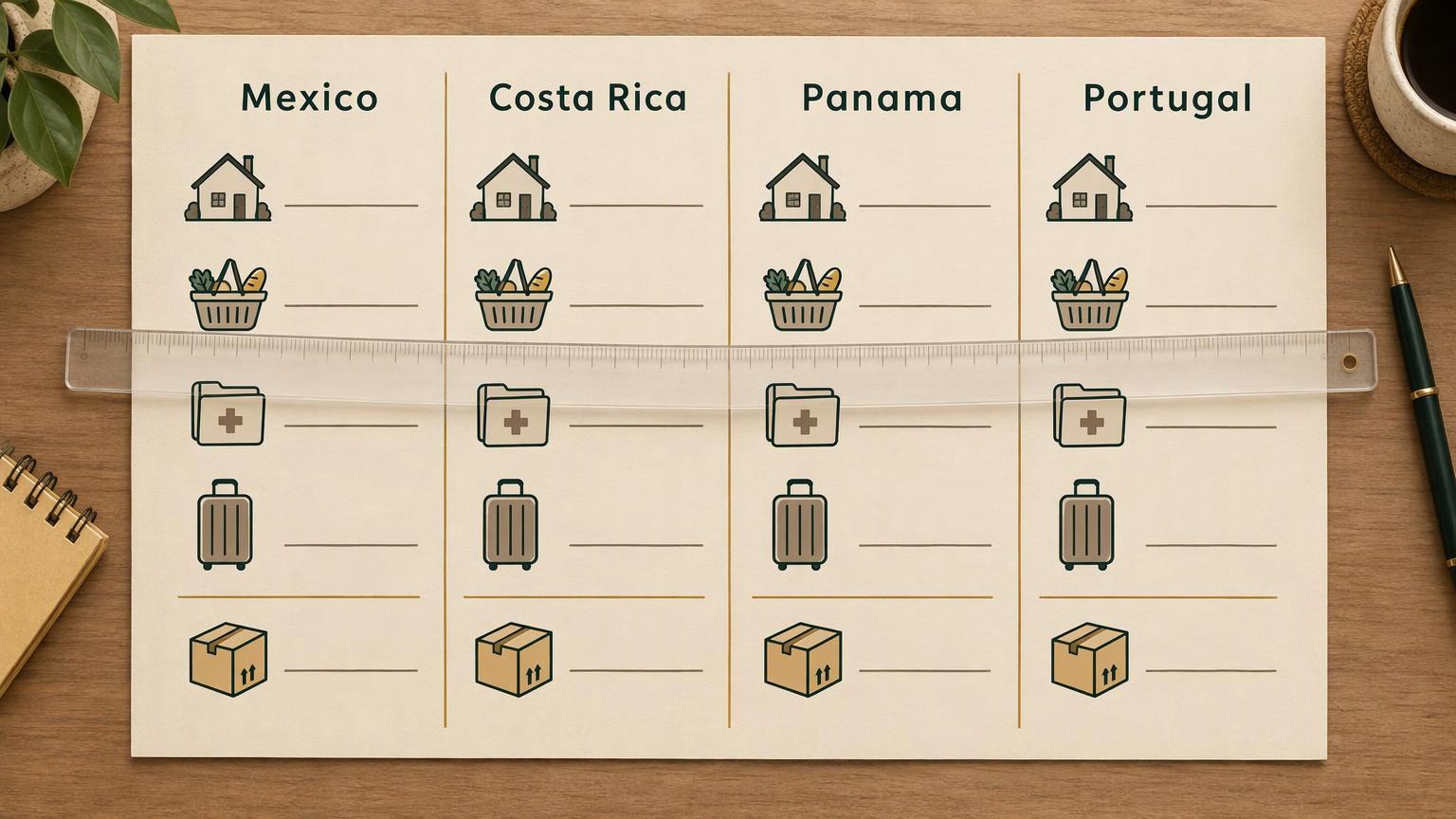
Illustration of a four-country comparison board with matching expense icons and blank writing lines. Dividers separate the box row, and a transparent ruler spans the columns.
Which questions need separate professional review?
Lifestyle fit and practical feasibility are different decisions. A destination can feel right while still requiring substantial review of medical access, lawful residence or cross-border finances.
Apply the same standard to all four countries. Treat each of the following as a separate workstream, rather than letting a favorable answer in one area stand in for the others.
Healthcare means your care needs, not a national reputation
Ask qualified medical and insurance professionals to assess the care pathway relevant to you. That review can address appropriate providers, prescriptions, emergency arrangements, coverage, exclusions and continuity of care.
A hospital's existence does not establish that it provides a particular treatment or that an insurance policy covers it. Likewise, a country-level reputation cannot establish access from the neighborhood where you would actually live.
Keep everyday wellness separate from medical claims. Outdoor time, social connection and an enjoyable routine are lifestyle preferences, not promises of better health or longer life.
Residency means a lawful plan for your intended stay
Full-time retirement and seasonal living involve different plans. Have an appropriately qualified immigration professional explain the current routes, documentation and obligations relevant to the intended pattern of residence.
Apply that review equally to Mexico, Costa Rica, Panama and Portugal. A program name or an older income threshold is not enough to establish eligibility, timing or approval.
Tax treatment means reviewing the whole picture
A qualified cross-border tax professional can assess how residence, income types, accounts and property interact in your circumstances. Keep that assessment separate from immigration eligibility and the household spending budget.
Do not count a supposed tax benefit as savings before that review. A simple country label cannot resolve the treatment of an individual's pension, investments or other income.
Can the place support your relationships and daily routine?
Compare the journey you would actually make, not an airport's presence on a map. For each candidate community, examine current routes for your intended season, connections, arrival logistics and the return journey.
Family access deserves its own weight. Someone happy to plan occasional visits has a different requirement from someone who wants frequent, flexible contact with relatives in the United States.
Then examine life between trips. Choose an ordinary weekday and map what you would want to do: buy groceries, attend an activity, meet a friend or get home after dinner.
- Can you manage the route and building access comfortably?
- Does the community have recurring activities you would genuinely attend?
- How much local-language learning are you willing to undertake?
- Would your routine still work without relying on vacation services?
Use the same questions in every country. An international community may make an initial introduction easier, but it does not tell you whether the people, activities or neighborhood suit you.
The downside of a quieter, scenery-led choice is that the daily routine may require more deliberate planning. The downside of a service-oriented urban choice is that it may not deliver the pace or setting that first attracted you abroad.
How would the comparison change for a real retirement plan?
Say you and your partner want outdoor time, a dependable social routine and regular visits with family in the United States. You like tropical scenery, but you also enjoy seasonal change and do not want choosing a home to decide the country for you.
Mexico and Costa Rica remain candidates for the coastal or tropical part of that brief. Panama deserves consideration if the choice between city living and coffee-country life helps clarify the routine you want. Portugal remains relevant because seasons and a European setting are genuine preferences, not minor extras.
Now suppose one partner considers regular family visits essential, while the other is more flexible about climate. The next comparison is actual travel access from candidate communities, followed by the same housing budget and independent professional reviews.
If Portugal's travel pattern does not meet the couple's family expectations, it can leave the shortlist despite its lifestyle appeal. If its route works and the European setting matters most to both partners, there is no reason to favor Mexico simply because this is a Mexico-focused business.
Alternatively, if tropical surroundings are the shared priority, Mexico and Costa Rica may deserve the next round of local comparison. The question then becomes which community supports the couple's routines, rather than which country's promotional description sounds better.
The useful outcome is a shorter list with a reason for each inclusion. It is not a declaration that one country wins every category.
Should the property decision wait until the destination fits?
Keep a preferred property from becoming evidence that the country suits you. A home can meet your aesthetic preferences while leaving daily access, social life or the intended pattern of residence unanswered.
Separate the lifestyle trial from the ownership question. A stay that resembles ordinary living can help you assess a community without treating a vacation experience as proof of year-round fit.
Ownership is a legal and financial decision, not simply the next step after liking a destination. In Mexico, the ownership structure depends on location and circumstances, including special structures in restricted coastal and border zones; qualified independent legal and tax professionals should review any transaction.
For Costa Rica, Panama and Portugal, use the same standard of independent local legal and cross-border financial review. Do not assume that a general statement about foreign ownership establishes the rights or obligations attached to a particular property.
Financing, availability, approval, appreciation, rental income and resale outcomes are not guaranteed. A retirement home should be evaluated against its intended personal use without making an unsupported return part of the reason to move.

Illustration pairing an everyday neighborhood walk with a separate tabletop arrangement of a paper house, folders and a magnifying glass.
Where does The Golden Life fit if Mexico remains a candidate?
The Golden Life provides destination and property guidance for Americans considering Mexico. Its starting point is your objective and priorities, including budget, timing, access, wellness and community, before individual opportunities enter the decision.
That role is useful after the country comparison, when you need to turn a broad interest in Mexico into a more focused destination direction. It does not establish Mexico as the best country for you or replace independent professional review.
The retirement and relocation hub provides a Mexico-specific next layer of context. If Mexico has earned a place on your shortlist, the Find your place lets you share your priorities and send an inquiry.