
Mexico real estate scams and buyer mistakes: what deserves a closer look

The practical response to Mexico real estate scams is to separate the seller's identity, authority to sell, property title, contract terms, and payment arrangements. A polished listing or an escrow label does not establish all of them. Common buyer mistakes include treating promises as evidence and comparing different property products as equivalents. Qualified independent professionals can evaluate the transaction-specific legal, technical, tax, and financial questions.
Table of Contents
- What separates a warning sign from a bad fit?
- What should a title check actually clarify?
- What does escrow address, and what does it leave open?
- Are you comparing the same kind of property rights?
- Which promises need more than a brochure?
- How does this change a real buying decision?
- Where does The Golden Life fit in a careful search?
- Frequently Asked Questions
Concerns about Mexico real estate scams often begin with a reasonable question: how can you tell whether an opportunity is what it appears to be? The answer is not a reassuring sales pitch or a longer list of alarming stories. It is understanding which evidence answers which question.
A real property can still come with unclear rights, unsuitable terms, or expectations that do not fit your life. This article explains the distinctions, with particular attention to title checks and escrow. It is general educational information, not legal, tax, financing, or investment advice for your circumstances.
What separates a warning sign from a bad fit?
A request to commit before questions are answered deserves scrutiny. So does a mismatch between the person presenting a property, the person identified in documents, and the proposed payment recipient. Neither automatically proves fraud, but each creates a specific question that reassurance alone cannot answer.
Other warning signs are about the quality of the explanation: important terms exist only in conversation, documents cannot be connected to the advertised property, or someone discourages independent professional review. The useful response is to identify the claim and the evidence needed to assess it, rather than argue about whether the seller seems trustworthy.
A disappointing purchase is not necessarily a scam. A home may be accurately described yet unsuitable for year-round living, or a legitimate ownership product may provide less control than the buyer expected.
That distinction matters because the remedies differ. Suspected deception needs professional assessment of the facts. Poor lifestyle fit needs a better comparison of how you intend to use the property, including community, access, maintenance, and time away.
The Golden Life's second-home and Mexico investment framework starts with intended use. Establishing that purpose helps keep an attractive property from becoming the answer to a question you never meant to ask.
Recognizing warning signs is different from deciding whether a destination or property fits your life.
What should a title check actually clarify?
A title check concerns the legal interests associated with a property. It is different from confirming that a building exists or that someone has keys. Those observations may be useful, but they do not establish ownership or authority to transfer rights.
In general, an independent legal review connects the property being offered with relevant ownership records, the seller's identity and authority, and any interests or restrictions that may affect the proposed transaction. The documents and procedures depend on the location, ownership structure, and circumstances.
The property and the seller are separate questions
One question is whether the documents describe the same property as the listing. Another is whether the person or entity signing has authority to sell the rights being offered. A correct property description does not answer the second question.
A useful discussion with qualified independent counsel can cover how the legal description relates to the physical property, what records support the claimed rights, and what establishes the signer's authority. A document packet is useful only if someone qualified explains what it establishes and what remains to be investigated.
Ownership records do not replace technical review
Legal rights and physical suitability require different evidence. Questions about boundaries, construction condition, utilities, permitted use, and development restrictions belong to the appropriate independent legal or technical professionals.
For example, an attractive parcel and a clear explanation of ownership would not, by themselves, establish that the buyer's intended home can be built there. Likewise, a completed building does not prove that every advertised use is permitted.
A destination and property report is not a title check. Legal questions belong with qualified independent legal professionals.
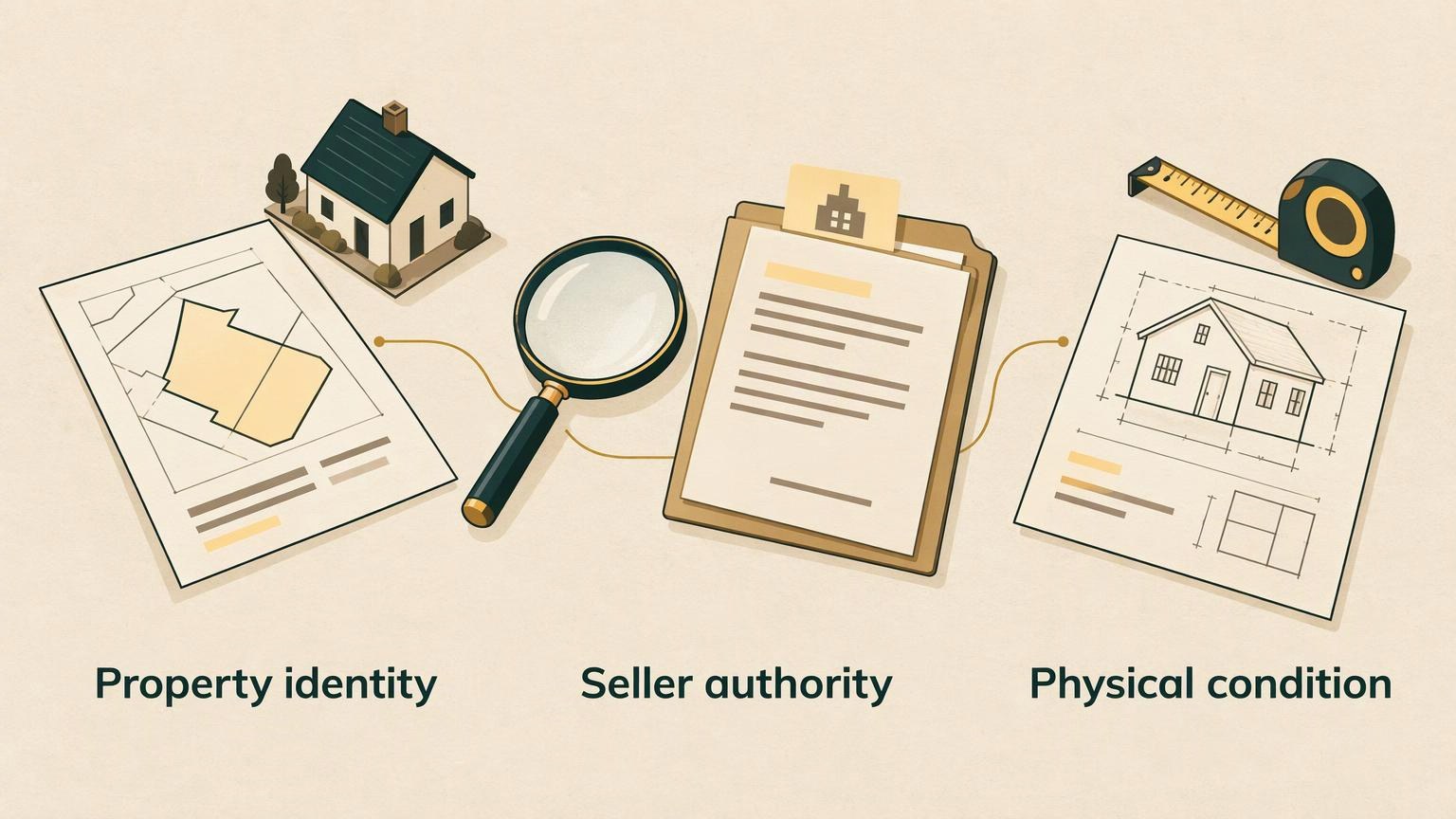
Illustration of three linked research areas labeled Property identity, Seller authority and Physical condition, with abstract documents, a miniature house, magnifying glass and tape measure.
What does escrow address, and what does it leave open?
In general, escrow is an arrangement in which a third party holds funds under agreed conditions. Its value depends on the agreement, the holder, and the conditions for releasing or returning the money. The word alone does not establish those protections.
Escrow addresses custody and release of funds. It does not independently prove good title, sound construction, permitted use, or that a seller will perform every obligation. Those questions require their own review.
A transaction-specific discussion with qualified independent legal and financial professionals can examine who holds the money, where it is held, whose instructions govern release, and how disagreement is handled. Availability, suitability, and terms cannot be assumed across Mexico property transactions.
Release conditions matter more than the label
A payment arrangement is easier to understand when it states what must happen before funds move, what evidence establishes that event, and who can authorize the release. A phrase such as money held securely leaves those questions unanswered.
Refund language also needs its own explanation. A promise that a deposit is refundable does not describe the triggering conditions, the process, or the treatment of a dispute. Independent counsel can interpret the actual terms rather than the sales summary.
Payment instructions need a separate identity check
Even a well-explained agreement leaves another question: do the payment instructions belong to the intended recipient? An email containing account details is not independent confirmation of that connection.
As a general fraud-prevention practice, verification through an independently established communication channel is stronger than relying solely on the message requesting payment. A last-minute account change deserves fresh verification, not automatic acceptance because earlier communication looked legitimate.
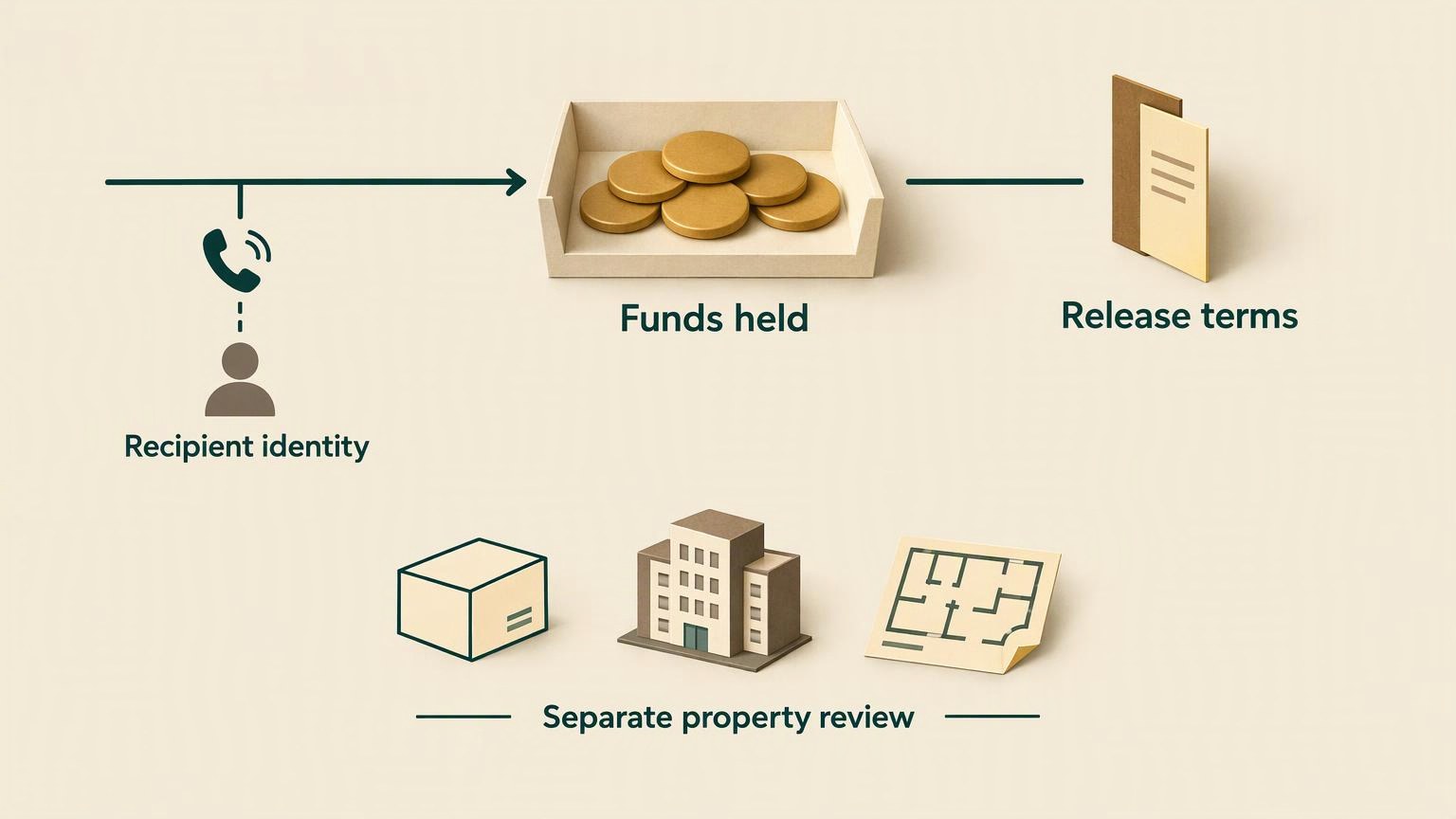
Illustration separating held funds and release terms from recipient identity and property review, using a paper tray, gate and grouped pictograms.
Are you comparing the same kind of property rights?
Full ownership, fractional arrangements, timeshare, and land are different products. Describing all of them as a Mexico property can obscure the rights, usage limits, continuing obligations, and exit options that determine whether each fits your purpose.
The following comparison explains general categories, not the terms of any particular offering. The actual documents and applicable rules determine the rights in a transaction, and a familiar product label does not settle the legal structure.
| Product | Rights and usage | Fees and obligations | Exit questions |
|---|---|---|---|
| Full ownership | An ownership interest, subject to the applicable structure and restrictions; intended occupancy and rental use need review. | Ownership expenses and any community or property-specific obligations. | How transfer works, what restrictions apply, and what costs accompany an exit. |
| Fractional arrangement | A shared interest or contractual arrangement; scheduling and decision-making depend on its documents. | Shared operating expenses, management charges, and possible additional contributions. | Transfer rules, approval requirements, and any buyout provisions. |
| Timeshare | Defined accommodation-use rights; the arrangement may or may not include a real-property interest. | Recurring charges and the rules governing changes or assessments. | Cancellation, transfer, termination, and continuing obligations. |
| Land | Rights in a parcel do not, by themselves, establish permission or practical ability to build. | Holding expenses and potential infrastructure or development obligations. | Transferability, title questions, and restrictions affecting future use. |
A lower entry amount is not a complete comparison
An entry payment measures only one part of the commitment. Usage limits, recurring obligations, control over decisions, and exit terms may matter more to someone planning to relocate than to someone seeking occasional accommodation.
Resale, appreciation, rental income, and returns are not guaranteed. A projected exit value cannot substitute for understanding the rights and obligations being purchased.
Which promises need more than a brochure?
Common buyer mistakes often start when a statement changes status without new evidence. An estimated completion date becomes a moving date. A rental projection becomes expected income. A verbal assurance becomes an assumed contract right.
Keeping those categories distinct makes the comparison more useful. A marketing statement expresses a claim, a contract describes agreed obligations, and independent verification examines supporting facts. None should silently stand in for the others.
Pre-construction and resale leave different questions open
A resale property generally provides an existing building to examine. Pre-construction involves a proposed or unfinished result, so delivery, specifications, permits, contract obligations, and payment structure carry additional importance.
An existing home still requires legal and technical review. Conversely, visible construction progress does not establish that every remaining obligation will be completed as described. Completion and delivery are not guaranteed.
This is a trade-off, not a universal ranking. A buyer with flexible use plans may evaluate an unfinished property differently from someone whose relocation depends on being able to occupy a home.
Financial projections are not property facts
A rental estimate depends on assumptions about use, demand, operating expenses, and management. It does not establish the income a buyer will receive. Appreciation claims likewise do not establish a future selling price.
Qualified independent financial and tax professionals can evaluate transaction-specific assumptions and obligations. Financing may be available for qualified U.S. buyers through licensed providers, but eligibility, property requirements, underwriting, rates, terms, fees, and approval apply.
A financing possibility is not approval. A property comparison built around borrowing therefore needs to distinguish potential routes from confirmed terms.
How does this change a real buying decision?
Say you are considering a Mexico home for retirement, with occasional visits before relocating. You see an existing home, an unfinished apartment, and a fractional arrangement marketed with appealing accommodation photos.
The existing home lets you examine present condition and everyday surroundings, while its title, permitted use, and obligations still need independent review. The unfinished apartment introduces delivery uncertainty that matters because your future housing plans depend on completion.
The fractional arrangement poses a different issue: whether its usage and scheduling rights support the life you want. Beautiful accommodation does not make occasional-use rights equivalent to a home available for continuous occupancy.
For this reader, the existing home is the clearer starting point because present-day suitability can be investigated directly. That does not make it legally sound or the right purchase. It means the next comparison can focus on a home that potentially matches the intended use, rather than relying on a future delivery or a different usage product.
If your aim were occasional stays and your timing were flexible, the comparison could lead elsewhere. The deciding factor is the dependency in your plans, not which offering has the most persuasive presentation.
| Option | What to assess | Planning issue |
|---|---|---|
| Existing home | Present condition and surroundings | Title and permitted use still need review |
| Unfinished apartment | Delivery, specifications and obligations | Housing plans depend on completion |
| Fractional arrangement | Usage and scheduling rights | May not support continuous occupancy |
Where does The Golden Life fit in a careful search?
The Golden Life connects destination and property direction to your intended life in Mexico. Its planning approach considers whether the objective is retirement, relocation, a second home, investment, or rental use, then compares fit through budget, timing, access, wellness, and community priorities.
That role is different from establishing legal title, interpreting transaction documents, or approving financing. Those decisions require current evidence and appropriately qualified independent professionals. A destination match cannot certify a property or remove transaction risk.
For someone still deciding what kind of home and destination to investigate, The Golden Life's Find your place provides an inquiry form through which you can ask about destination and property direction. It does not imply approval, financing terms, or property availability.
The practical distinction is between narrowing a search and validating a purchase. A clearer search can identify relevant questions; independent due diligence must still address the actual property and transaction.