
How to verify a developer in Mexico before you pay

To verify a developer in Mexico before paying, separate four questions: what is being offered, what is ready today, what obligations continue after purchase, and who checks the evidence independently. A recognizable brand or finished building does not answer all four. Qualified independent legal, technical, tax, and financial professionals assess the relevant documents and circumstances; a sales presentation is not a substitute.
Table of Contents
Learning how to verify a developer in Mexico starts with separating the seller from the project. A company may have completed other buildings, yet the particular property you are considering still needs its own review. The proposed use also matters: a retirement home, an occasional second home, and a rental property raise different practical questions.
The Golden Life's framework for buying a second home or investing in Mexico connects property fit with independent verification. This article is general educational information, not professional advice. It explains how to organize the questions without declaring any developer legitimate or any purchase suitable.
What exactly is the developer offering?
The first distinction is between the name on the brochure and the parties identified in the proposed transaction. A development's marketing name does not, by itself, explain who owns the property, who is selling it, who signs the agreement, or who receives payment.
A useful review connects the exact seller, project, property description, agreement, and proposed payment recipient. Different names are not automatically evidence of wrongdoing, but the relationship between them needs an explanation that an independent professional can assess.
The same discipline applies to the product. An image of a furnished condo does not establish whether furnishings, parking, storage, common facilities, or management services are included. Nor does vacation-style marketing explain the ownership or usage structure.
Identify the product before comparing its appeal
Full ownership, fractional interests, timeshare arrangements, and land are different products. Their rights, usage provisions, fees, and exit terms should not be treated as interchangeable. Qualified independent professionals can explain the structure in the actual documents rather than infer it from the sales language.
For a condo proposal, a useful comparison pairs the specific property description with the floor plan, specifications, inclusions, and exclusions. A model unit may help you picture daily life, but it is not proof that the offered unit has the same dimensions or finishes.
Connect developer history to the proposed seller
Past projects can help frame questions about delivery and maintenance. The relevant issue is what role the proposed seller or developer had in those projects, not merely whether photographs appear in a portfolio.
A completed building associated with a related company may be useful context. It does not establish the current seller's obligations or capacity for this project. A clear account separates the marketing brand, the contracting party, and the documented history attributed to each.
Understanding who is offering the property is one question. Whether it fits the life you want in Mexico is another.
What is ready today, and what is still planned?
Readiness is more specific than a label such as pre-sale, under construction, or completed. The home, common areas, utilities, access, and management arrangements may each be at a different stage. A useful assessment keeps those elements separate.
This is why questions about a developer's permits for a condo in Mexico belong alongside a technical assessment. The issue is not whether a document called a permit exists. It is whether the relevant documentation applies to the exact site, proposed work, and current stage, as assessed by qualified independent professionals.
This guide does not prescribe a universal permit list. Requirements and their significance need current, location-specific professional review. A document for another phase or an earlier design cannot simply be assumed to answer questions about the property now being offered.
| Project stage | What can be examined | What remains a separate question |
|---|---|---|
| Planned | The proposal, design, specifications, and available project documentation | How the proposed work, delivery commitments, and payment structure are supported |
| Under construction | Existing work and its relationship to the plans and specifications | What remains unfinished and how progress claims have been independently assessed |
| Physically completed | The actual property, visible condition, and delivered facilities | Documentation, defects, ongoing operations, and the transaction terms |
Distinguish a site visit from a technical assessment
A visit can reveal that a promised facility is absent or that the offered unit differs visibly from a model. It cannot establish every technical or documentary issue. A qualified independent technical professional can define what an inspection covers and what it does not.
Progress photographs also have limits. Their date, location, and relationship to the offered unit matter. A photograph of completed work elsewhere in the project does not establish the status of your proposed home.
| Project stage | Examine | Still review |
|---|---|---|
| Planned | Proposal, design, specs, project documents | Delivery commitments and payment structure |
| Under construction | Existing work against plans and specs | Unfinished work and assessed progress |
| Physically completed | Actual property and delivered facilities | Documents, defects, operations, terms |
The difference between ready today and planned for later matters when you picture your everyday life in Mexico.
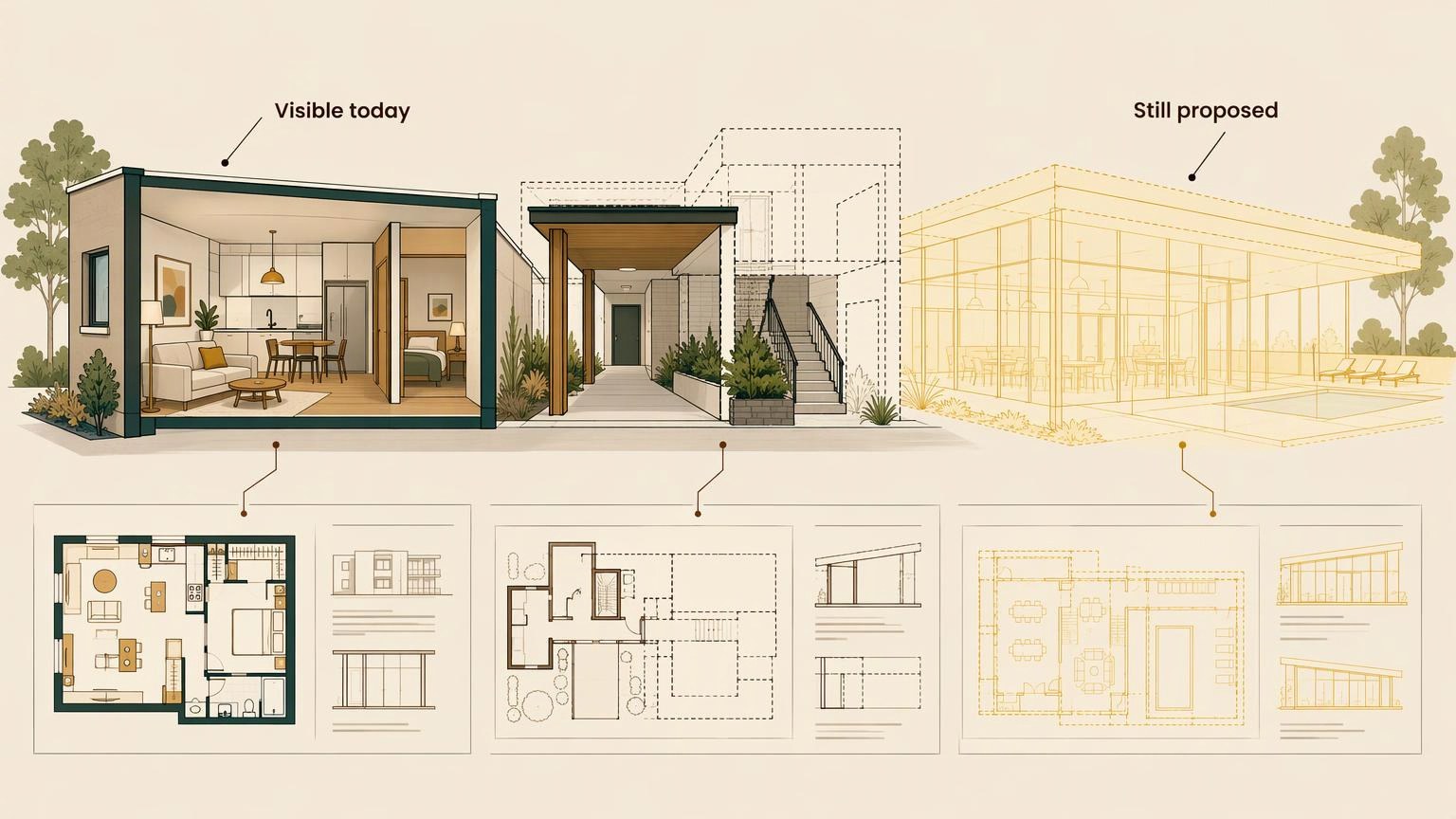
Illustration contrasting solid and proposed architectural components, labeled “Visible today” and “Still proposed,” with corresponding plan sheets below.
What continues after the purchase?
A property's usefulness depends partly on what happens after delivery. Maintenance, management, common-area operation, owner obligations, and exit considerations deserve their own review. A completed unit can still be a poor fit if the ongoing arrangements do not match the way you intend to use it.
For someone living there full time, dependable everyday operation may matter more than a planned amenity. For an occasional visitor, the management arrangement may be more important. Rental use introduces additional questions that require independent legal, tax, financial, and investment review.
Separate the home from its service promises
Marketing may describe maintenance, rental management, concierge services, or future facilities. The meaningful distinction is whether a service is part of the transaction, separately contracted, optional, or only proposed. Each description has different implications for the buyer's expectations.
Useful questions address who provides the service, how charges are determined, what can change, and how complaints or termination are handled. Specific fees and policies belong in current supporting documents, not assumptions based on another development.
Make responsibility visible
A handover date does not explain who deals with a defect, maintains shared equipment, or operates common facilities. Those responsibilities need to be traced to the relevant parties and terms for independent review.
Exit deserves similar attention. Resale, transfer, and ending a service arrangement are different matters. Neither attractive marketing nor developer history guarantees resale, appreciation, rental income, or returns.
Who checks the evidence independently?
Independent verification means more than hearing the same explanation from another person involved in selling the property. The reviewer needs an appropriate scope, relevant qualifications, and a clear account of whom the review is for. Referral relationships and compensation can also matter to the reader's assessment of independence.
Legal and technical questions require different expertise. A review of seller identity and transaction documents does not establish construction quality. A building inspection does not settle ownership, tax treatment, or the meaning of a contract.
Qualified independent legal professionals can explain which ownership, authority, contract, and project records are relevant. Qualified technical professionals can assess the physical issues within their scope. Tax, financial, and investment questions need appropriately qualified independent professionals for the reader's circumstances.
Trace the claim instead of collecting document names
A useful evidence record begins with the claim: the unit includes parking, a facility is complete, or a particular party is responsible for delivery. It then identifies the supporting document or observation, its date, and who has assessed it.
This makes the difference between a document supplied by the seller and a claim checked independently visible. It also prevents a general company document from being treated as confirmation of a specific property's status.
Understand the limits of a review
A professional conclusion should be read within its stated scope and date. A review of one document does not imply that every project issue has been examined. Older information may need reassessment if the design, parties, work, or proposed terms change.
A good explanation distinguishes facts examined, assumptions used, and questions requiring another professional's work. Independent review improves the basis for a decision; it does not guarantee delivery, approval, or a legal or financial outcome.
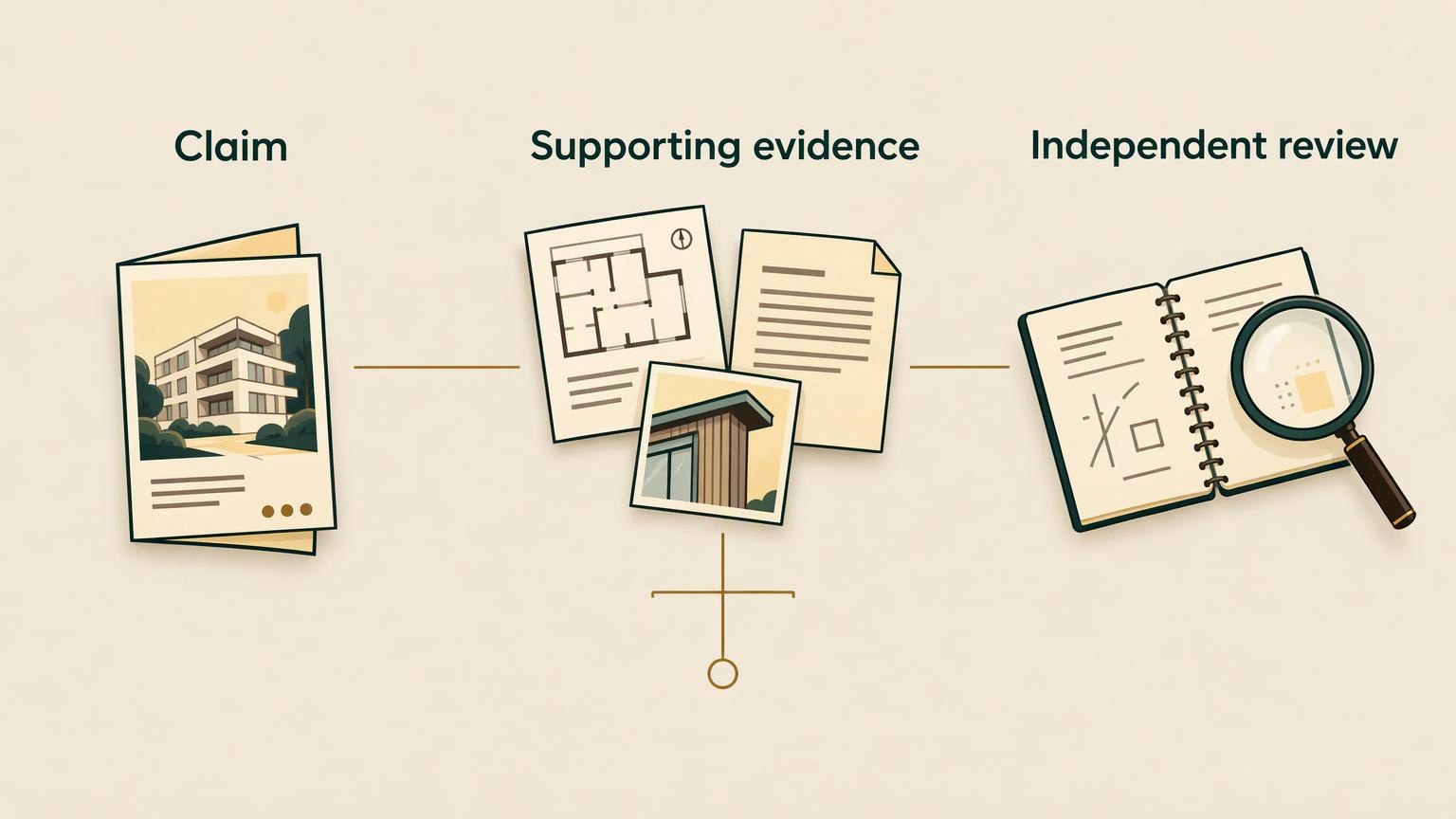
Illustration linking a property brochure to supporting documents and a building-detail image, then to a notebook and magnifying glass for independent review; a lower branch ends in an open circle.
How does the framework change a property comparison?
Say you want a home for year-round living and are comparing a physically completed condo with a planned condo that has more appealing renderings. The planned property includes a proposed shared facility that would be useful but is not essential to your daily routine.
Start with what each proposal lets you evaluate. The completed property allows examination of the actual unit and existing facilities, although its documents, condition, and ongoing obligations still need independent review. The planned property requires greater reliance on specifications, project documentation, and future commitments.
If your priority is understanding the home as it exists, the completed property is the closer match for that comparison. This does not establish that its seller is legitimate or that the transaction is suitable. It explains why a rendering of a better facility should not outweigh evidence relevant to your stated priority.
The trade-off is real: choosing an existing property may mean accepting a layout or finish you would not have selected. Choosing a planned property may give more weight to a design you prefer, while leaving more of the promised experience to be delivered later. The four questions expose that difference without assigning either option a universal advantage.
The Golden Life begins with intended use, lifestyle, and property direction. Its Find your place lets you share your priorities and send an inquiry. That step helps frame fit; it is separate from developer verification and independent transaction review.
How do the findings connect to a payment decision?
The final educational distinction is between information gathered and a decision assessed. A thick document package can still leave a material promise unexplained. A short, clearly organized record can make it easier for qualified independent professionals to identify what their review needs to address.
Questions to ask a developer in Mexico become more useful when they connect across the four categories. If a facility is included in the offer but is not ready, the review also needs to examine who is responsible for it and how that commitment appears in the relevant documents.
The proposed payment deserves the same connection. Its purpose, recipient, relationship to the agreement, and applicable conditions are matters for professional review. A payment described as a reservation, deposit, or advance should not be treated as interchangeable merely because each occurs before delivery.
The practical result is a record of the proposal, its current state, ongoing obligations, and independent findings. That record supports a better-informed professional conversation. It does not turn this guide, a destination report, or a seller's assurances into authorization to pay.