
How to pay for a house in Mexico: cash, U.S. mortgage or HELOC?
You may pay for a house in Mexico from existing cash or explore financing, subject to eligibility and terms. Borrowing against a U.S. home is different from financing secured by the Mexican property. A HELOC may provide purchase funds if the provider permits that use, but the U.S. home secures the debt. A qualified independent lender or financial professional must assess availability and suitability.
Table of Contents
- What actually differs between cash, a mortgage and a HELOC?
- What does paying cash for property in Mexico change?
- Can you buy a house in Mexico with a U.S. mortgage?
- Can you use a HELOC to buy property in Mexico?
- Can you get a mortgage in Mexico as a retiree?
- How can the same purchase lead to different funding choices?
- What separates a funding plan from a completed purchase?
- Where does The Golden Life fit in this decision?
- Frequently Asked Questions
The key to understanding how to pay for a house in Mexico is separating the source of your money from the property that secures any borrowing. A seller may receive cash even when you borrowed that money elsewhere. That distinction changes which home is exposed to repayment risk and how the purchase fits your retirement or second-home plans.
This is general educational information, not financial, investment, legal or tax advice. The comparison belongs within the broader decision to buy a second home or invest in Mexico, with material facts independently verified and personal decisions reviewed by appropriately qualified professionals.
What actually differs between cash, a mortgage and a HELOC?
There are separate questions: how the seller receives payment, whether you owe money afterward, and what secures that debt. Calling a transaction a cash purchase answers only part of the picture.
Existing savings can fund a purchase without a new loan. A mortgage intended for the Mexican property is a separate financing route. A HELOC draws on equity in a U.S. home and creates a borrowing obligation there, even if the Mexican seller receives the proceeds as cash.
Financing may be available for qualified U.S. buyers through licensed providers. Eligibility, property requirements, underwriting, rates, terms, fees and approval apply. These categories explain the differences; they do not establish that a particular product is available to you.
| Route | Source of purchase funds | Collateral question | Main trade-off |
|---|---|---|---|
| Existing cash | Money already available to the buyer | No new loan collateral from this funding route | No new purchase-loan payment, but less liquid money remains |
| Financing for Mexican property | Loan proceeds under an approved property-financing arrangement | Whether and how the Mexican property secures the loan | Some cash may remain available, but financing adds costs, conditions and repayment obligations |
| U.S. home equity borrowing | Proceeds borrowed against a U.S. home | The U.S. home secures the borrowing | The Mexico purchase uses funds from a debt tied to another home |
| Route | Funds | Collateral | Main trade-off |
|---|---|---|---|
| Existing cash | Money already available | No new loan collateral | No new loan payment; less liquid cash |
| Financing for Mexican property | Approved property-financing loan | Confirm how Mexican property secures loan | May retain cash; adds costs and repayments |
| U.S. HELOC | U.S. home equity, if use is permitted | U.S. home secures the debt | Repayment problems can risk the U.S. home |
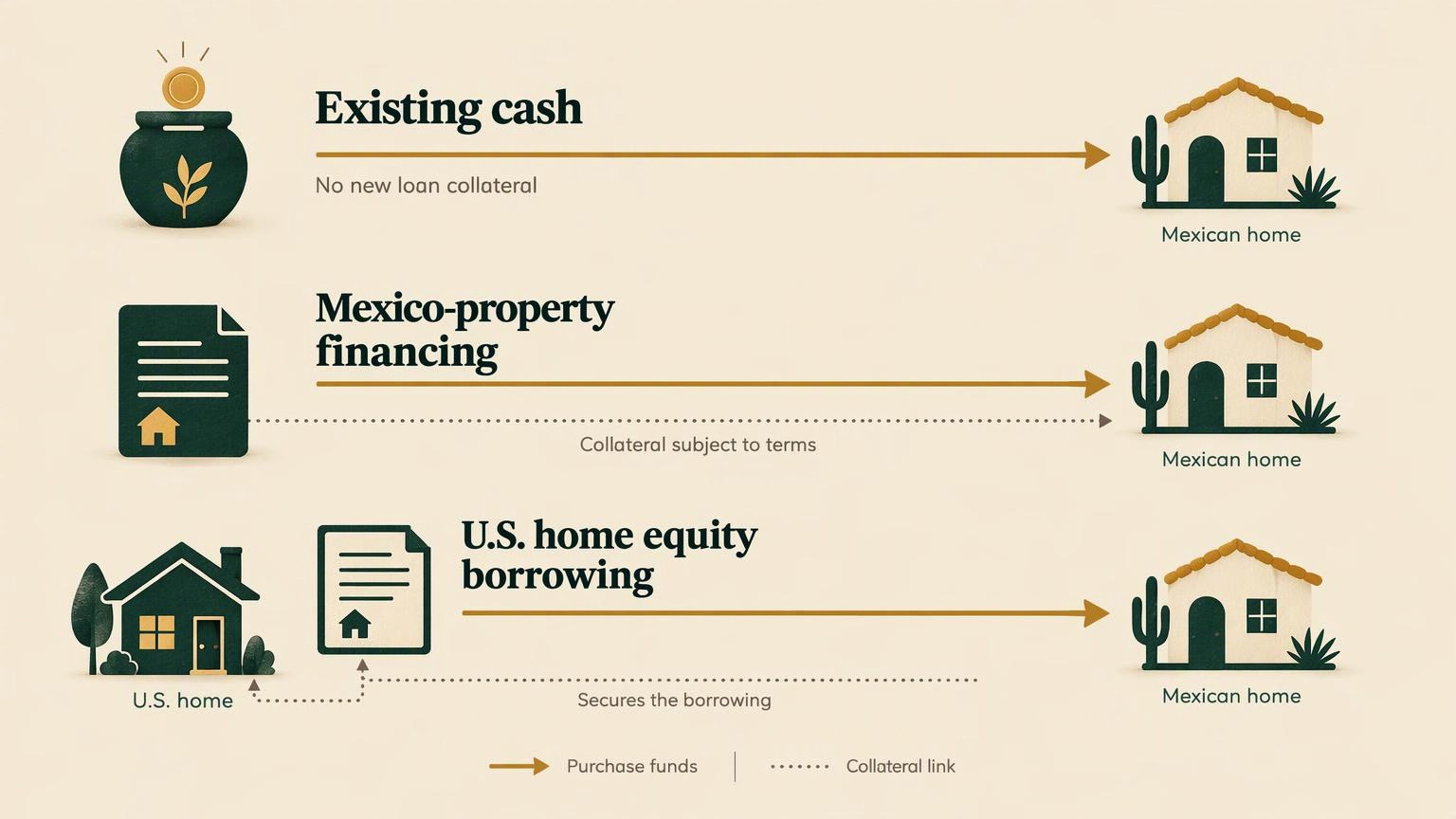
Illustration comparing existing cash, Mexico-property financing and U.S. home equity borrowing, using gold arrows for purchase funds and dotted lines for collateral links.
What does paying cash for property in Mexico change?
Paying from existing cash removes the need for a new purchase loan. It does not remove ownership costs, transaction costs or the need to verify the property and payment arrangements.
The useful comparison is between money committed to the purchase and money remaining afterward. Cash held in an account is different from money that would first need to come from an investment sale, retirement-account withdrawal or home sale. Those sources may have consequences that require financial and tax review.
Cash also has a liquidity trade-off. A home cannot be treated as readily available spending money, and a future sale has no guaranteed price or timing. For a retiree, that matters separately from whether the purchase price can be paid today.
An all-cash offer should not be treated as proof that a transaction will be faster, cheaper or legally simpler. The agreement, property documentation and fund-transfer arrangements still determine what must happen before completion.
Can you buy a house in Mexico with a U.S. mortgage?
Do not assume a mortgage product for U.S. property can finance a Mexican home. A provider's willingness to lend to an American borrower is different from its ability to finance a property in Mexico.
The phrase U.S. mortgage can mean different things: borrowing secured by an existing U.S. home, or seeking a financing arrangement intended for the Mexican property. The lender's location alone does not explain the loan's structure.
For financing tied to Mexican property, buyer eligibility and property eligibility are separate reviews. A buyer's financial profile does not establish that a particular location, property type, title arrangement or completion status satisfies a provider's requirements.
For borrowing against a U.S. home, the Mexican purchase does not change which home secures the U.S. debt. The loan agreement governs permitted use, repayment and other obligations.
The Golden Life's financing overview for U.S. buyers provides context for these conversations. Current availability and terms require a qualified provider's assessment, not an assumption based on a domestic mortgage advertisement.
A preliminary assessment is not money ready to transfer
An initial financing discussion does not establish final approval or the date funds will be available. Buyer documentation, property requirements and other conditions may remain.
That distinction matters when a purchase agreement has payment deadlines. The relationship between financing conditions and contractual obligations requires independent legal review; a general indication of borrowing capacity does not resolve it.
Can you use a HELOC to buy property in Mexico?
A home equity line of credit, or HELOC, may provide funds for a Mexican purchase if the provider permits that use and the borrower meets the applicable requirements. It is borrowing secured by the home against which the line is established, not automatically financing secured by the Mexican property.
A HELOC is a credit line rather than simply a purchase-price payment. Its agreement determines access to funds, interest calculations, repayment requirements and other conditions. An approved limit, an amount currently accessible and an amount affordable to repay are different concepts.
The downside is direct: repayment problems can put the U.S. home at risk under the loan terms and applicable law. The Mexican property's value or a planned future sale does not remove that obligation.
Comparing only the starting monthly payment can obscure how the product works over time. Relevant terms include whether the rate can change, how payments change, and what happens when the borrowing or repayment phase changes.
A HELOC and a home equity loan are also different products. A qualified provider can explain the actual structure being offered and whether the intended use is permitted. Neither should be described as a universal shortcut around the financial or legal work of a Mexican purchase.
Can you get a mortgage in Mexico as a retiree?
Retirement does not establish either eligibility or ineligibility on its own. Financing may be available for qualified U.S. buyers through licensed providers, but a provider must evaluate the applicant, property and current requirements.
The retirement-specific issue is the difference between wealth and income accepted for underwriting. Pension payments, investment income, account withdrawals and assets available for a purchase are not interchangeable. A provider determines which evidence it accepts and how it evaluates that evidence.
A retiree may be able to pay cash yet prefer to retain liquid assets. Another may have home equity but find a new repayment obligation difficult to accommodate. These are questions for an independent financial professional, separate from whether a lender is willing to approve a loan.
Qualification and retirement affordability are separate
A financing decision addresses the provider's requirements. Retirement affordability considers the broader household picture, including existing debt, everyday spending and the costs of maintaining homes in different countries.
Income may be received in one currency while some expenses occur in another. Changes in exchange rates, household needs or borrowing payments can alter that picture. A qualified professional can evaluate those interactions without relying on hoped-for rental income or appreciation.
Moving and keeping a U.S. home create different questions
A retiree planning to keep a U.S. home has a different funding picture from someone expecting to sell it. Using that home as collateral can connect both housing plans to the same repayment obligation.
The broader retirement and relocation decision includes how you expect to live, not merely whether you can qualify for financing. Provider-specific occupancy, documentation and loan requirements need separate verification.
How can the same purchase lead to different funding choices?
Say you are retired, own a U.S. home and want a Mexican second home. You have liquid savings, but you also want money available for everyday spending and changes in your plans.
Existing cash would avoid a new borrowing payment. The trade-off is committing part of your accessible money to property. The relevant question is what remains after the full purchase, not merely whether the asking price fits your account balance.
A HELOC could leave some savings untouched, but it would connect the second-home purchase to debt secured by your U.S. home. Retaining cash would therefore come with repayment costs and collateral exposure, rather than being a free benefit.
Financing intended for the Mexican property would require a separate assessment of both you and the property. It might preserve some liquidity, but that possibility cannot be treated as an available solution until the provider establishes eligibility and terms.
No route wins from these facts alone. If avoiding a new obligation is the dominant priority, existing cash is the route that directly addresses it. If retaining accessible funds matters more, borrowing routes merit professional comparison, including which home secures the debt and whether payments fit the retirement plan.
If none of the routes fits the household's needs, changing the purchase budget or postponing ownership remains part of the discussion. A property's appeal does not settle the funding decision.
What separates a funding plan from a completed purchase?
Having enough money is only one part of completion. A transaction also needs an appropriate ownership structure, reviewed documentation and a payment process consistent with the agreement.
Americans can own property in Mexico, but the ownership structure depends on location and circumstances, including special structures in restricted coastal and border zones. Qualified independent legal and tax professionals are needed for the transaction.
Borrowing against a U.S. home does not resolve those Mexican ownership questions. Nor should a financing review be treated as a substitute for independent review of title, contracts, technical condition or other material property facts.
The amount the buyer sends, the currency required by the agreement and the amount ultimately received may differ because of conversion and transfer arrangements. Banks and transaction professionals can explain those mechanics for the specific purchase.
Payment instructions also require verification. A qualified transaction professional can clarify the authorized recipient, supporting documentation and release conditions. An email requesting payment is not, by itself, evidence that all purchase requirements have been satisfied.
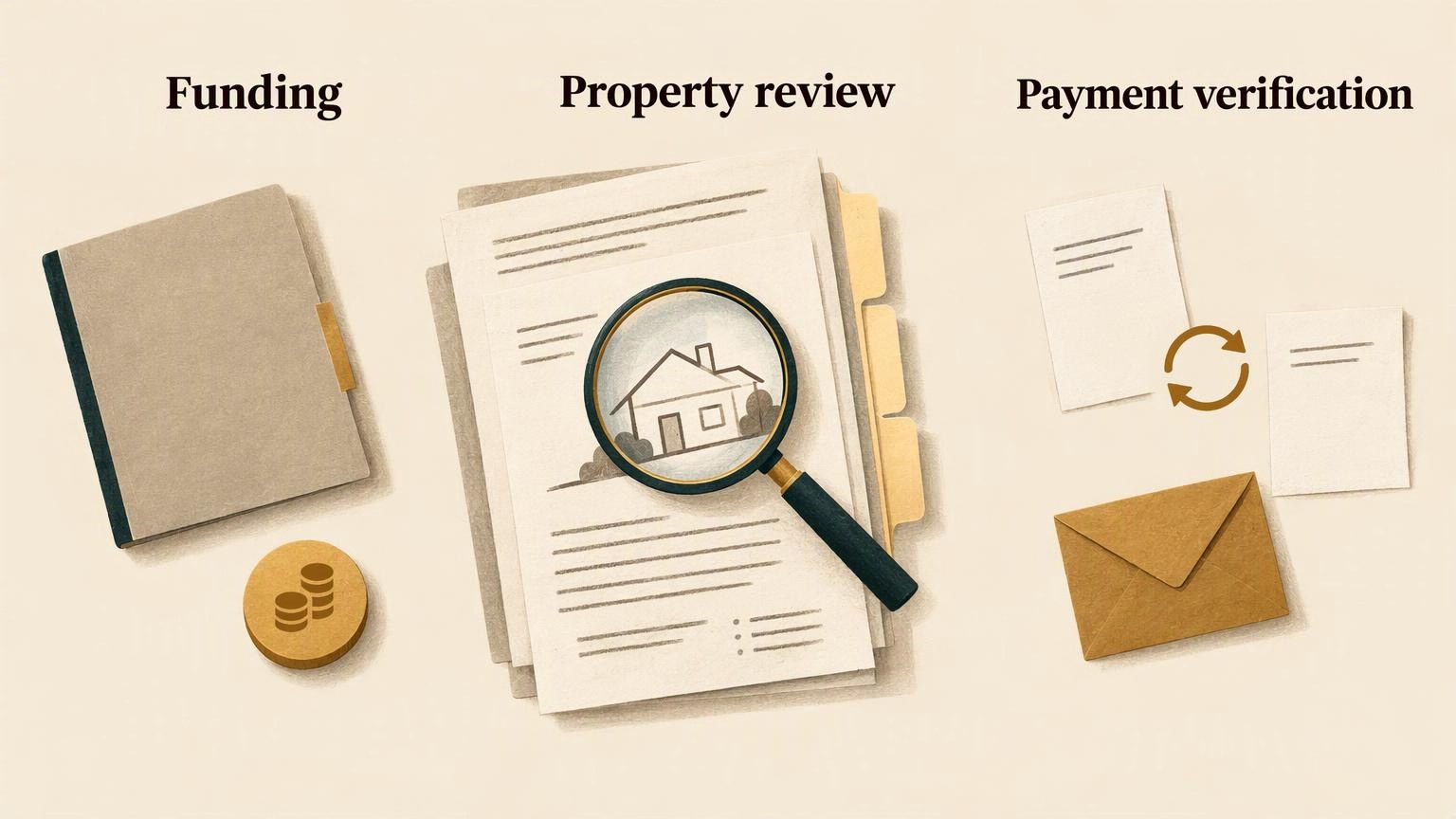
Illustration with three separate desk groups labeled Funding, Property review and Payment verification, featuring a magnifying glass examining a house outline on papers.
Where does The Golden Life fit in this decision?
The Golden Life provides destination and property guidance for Americans considering retirement, relocation, a second home or investment in Mexico. Its relevant role starts with the intended use of the home and the life you want to live.
That helps distinguish a full-time retirement plan from a seasonal second home or rental-use objective before individual properties dominate the conversation. Budget, timing, access and community priorities give the property search a clearer direction; they do not establish borrowing approval.
Once those priorities are clearer, The Golden Life's Find your place lets you share your priorities and send an inquiry. The report is destination and property guidance, not a financing approval, loan offer or promise of property availability.