
Fractional ownership in Tulum: understanding fees, usage weeks and deeded shares

Fractional ownership should be evaluated through separate ownership, usage, and payment documents. A share does not, by itself, establish your booking dates, total costs, or ability to sell. For fractional ownership in Tulum, specific fees and usage weeks must come from current, dated product documents, while the ownership structure requires review by qualified independent legal and tax professionals.
Table of Contents
- What does a fractional share actually tell you?
- How should you compare fractional ownership fees?
- How do usage weeks become dates you can book?
- What does the phrase deeded share establish?
- When might renting fit better than a fractional share?
- How can you tell whether the documents describe the same offer?
- Where The Golden Life fits in your property exploration
- Frequently Asked Questions
This follow-up to The Golden Life's fractional home ownership in Mexico guide examines the distinction between fees, usage rights, and ownership interests. If you are exploring fractional ownership in Tulum, the next question is whether the documented arrangement supports the way you actually want to spend time in Mexico.
A property interest, an annual calendar allocation, and an ongoing payment obligation are related, but they are not interchangeable. Understanding each separately helps you compare a shared home with full ownership or renting. This article does not cite approved, dated product documents establishing a particular offering's fees or usage rules, so it cannot provide those product-specific terms. The explanations below are general education, not offering terms or professional advice. Any transaction requires independently verified facts and appropriately qualified professionals.
What does a fractional share actually tell you?
The word fractional describes a divided interest. It does not fully describe the interest being sold, the calendar attached to it, or the authority you would have over the property.
For a lifestyle buyer, the useful distinction is between an economic interest and practical access. A proposal might discuss ownership while describing occupancy elsewhere. Reading those as separate subjects prevents an ownership percentage from becoming an assumed promise about holidays or extended stays.
Full ownership, fractional interests, timeshares, and land also answer different needs. The table distinguishes the questions each product raises rather than treating one label as automatically better.
| Product | Ownership question | Usage question | Cost and exit question |
|---|---|---|---|
| Full ownership | What property and rights are included? | What restrictions affect occupancy or rental use? | What ongoing obligations and transfer conditions apply? |
| Fractional interest | What interest is acquired, and how is it documented? | How is access allocated among participants? | How are shared costs assigned, and how can the interest transfer? |
| Timeshare | Is the arrangement ownership-based or a contractual use right? | What accommodation and booking entitlement are included? | What recurring charges and transfer conditions apply? |
| Land | What parcel and rights are included? | What use is permitted, and what must happen before occupancy? | What ownership, development, and transfer obligations apply? |
Keep the lifestyle question separate from the investment question
Wanting a familiar home for repeat visits is different from wanting rental income or an eventual resale gain. A calendar that suits personal stays does not establish an investment outcome, and an ownership interest does not establish permission to rent.
For a lifestyle comparison, focus first on access and ongoing obligations. Rental income, appreciation, returns, financing approval, and resale outcomes are not guaranteed.
How should you compare fractional ownership fees?
Compare costs in separate layers rather than treating the purchase price as the complete commitment. The useful question is not simply whether a fee sounds reasonable, but what it covers and what remains outside it.
Actual amounts, billing frequency, increases, and payment obligations must come from the offering's dated documents. General averages cannot establish the cost of a particular share, and a different property's fee schedule cannot fill that gap.
The following categories are a way to organize a comparison. They are not a statement that every offering charges each item.
| Cost layer | What the comparison should distinguish | Relevant documentation |
|---|---|---|
| Acquisition | The interest price versus transaction-related charges | Dated purchase terms and itemized transaction estimate |
| Recurring operation | Included services versus separately billed services | Current fee schedule, operating budget, and management agreement |
| Property reserves | Routine upkeep versus funding for replacements or major work | Reserve policy, budget, and applicable assessment provisions |
| Use and transfer | Charges tied to stays, guests, rentals, or a change of owner | Current usage rules and transfer provisions |
Shared expenses are still expenses
Sharing costs can distribute responsibility across participants. It does not establish that total costs are lower than renting, that fees remain unchanged, or that every service is included.
Distinguish an operating budget from a contractual payment obligation. A budget explains anticipated spending; the governing terms explain how costs are allocated and who can authorize changes. Qualified independent professionals can evaluate the financial and legal significance of those documents.
Compare against stays you can realistically take
For a lifestyle comparison, relate the documented recurring costs to the nights you reasonably expect to use. Keep acquisition costs and any financing separate so that the comparison does not hide them.
If you can travel only during a narrow season, access during other periods may have little practical value to you. Do not assume unused time produces a refund, rental income, or a credit unless the applicable dated terms expressly provide it.
How do usage weeks become dates you can book?
A stated allocation of weeks describes an amount of time. It does not necessarily describe which dates you can reserve, how far ahead you can reserve them, or whether those weeks can run together.
Start with your travel pattern. Someone with flexible dates can evaluate a booking system differently from someone tied to a work calendar or family holiday. The same headline allocation can have different practical value for those readers.
These are general scheduling concepts, not the booking rules of a particular Mexico property.
| Scheduling concept | Basic idea | Potential fit | Trade-off to resolve in the terms |
|---|---|---|---|
| Fixed periods | Access is attached to designated periods | A repeat travel pattern | Changing those periods may be limited |
| Rotating periods | Access or selection priority changes under a defined rotation | Travel plans that can adapt over time | Preferred periods may not recur every year |
| Floating reservations | Dates are selected within an eligible calendar | Flexible travel within that calendar | Eligibility does not establish availability |
| Points-based access | Reservations use an allocation of points | Different stay lengths or booking choices | An allocation does not establish a fixed number of usable nights |
Entitlement, request, and confirmation are different
An entitlement defines the access allocated to you. A request asks for specific dates. A confirmation establishes the reservation under the applicable rules.
Those distinctions matter when planning flights, inviting family, or arranging a longer stay. A preferred-date request is not the same as a confirmed visit, and a nominal allocation does not prove uninterrupted occupancy.
The calendar details can change the decision
Booking priority, eligible seasons, consecutive-stay limits, maintenance closures, and cancellation treatment affect practical access. Guest use and rental use are separate questions rather than automatic extensions of personal occupancy.
A useful calendar comparison follows the dates you want through the actual reservation process. It should explain how competing requests are resolved and what happens when your plans change, without assuming that unused access carries forward.
| Scheduling | Potential fit | Limit to check |
|---|---|---|
| Fixed periods | Repeat travel pattern | Changing periods may be limited |
| Rotating periods | Plans that adapt over time | Preferred periods may not recur yearly |
| Floating reservations | Flexible dates in an eligible calendar | Eligibility does not prove availability |
| Points-based access | Different stay lengths or choices | Points do not establish fixed nights |
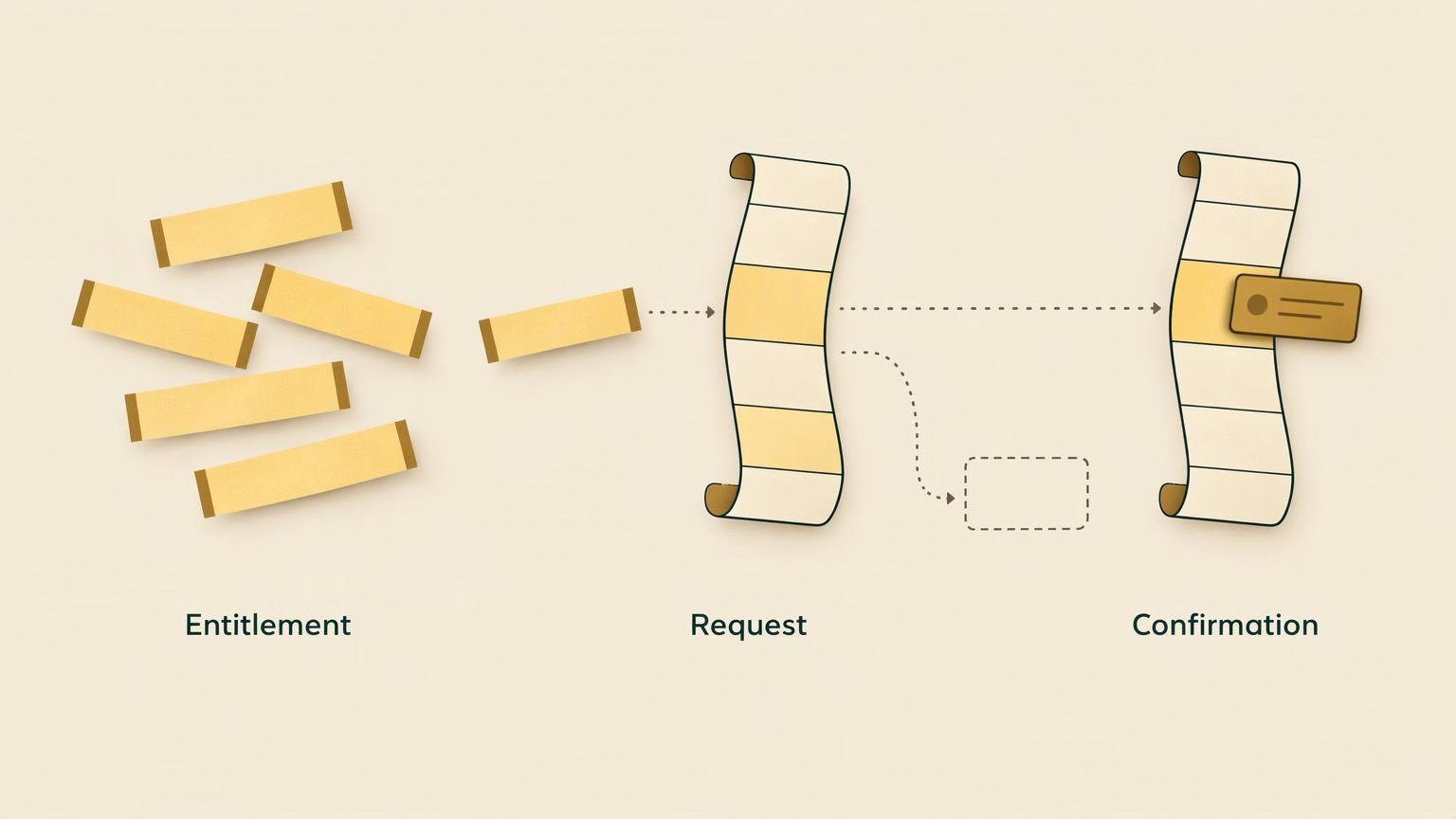
Illustration of Entitlement, Request and Confirmation using gold strips, segmented ribbons and a reservation card, with a branching dotted path to an empty outline showing an unresolved alternative.
What does the phrase deeded share establish?
A deeded-share label is an ownership claim, not a complete description of the transaction. It cannot establish, on its own, what interest is transferred, which obligations attach to it, or how you may use or transfer it.
For Mexico property, the ownership structure depends on location and circumstances, including special structures in restricted coastal and border zones. Qualified independent legal and tax professionals are needed to assess any transaction.
The educational distinction is straightforward: an ownership document addresses the interest, while a usage agreement addresses access. Neither should be treated as a substitute for the other.
Ownership does not answer every control question
Sharing a property raises decisions about maintenance, budgets, management, and changes to the home. The ownership label does not tell you who can make those decisions or what approval process applies.
For someone who wants to renovate freely or change management independently, shared governance may be a meaningful downside. For someone who prefers defined procedures, the same arrangement may feel more manageable. The relevant rights must be established by the governing documents, not the sales description.
Ownership and resale are separate questions
An interest that can transfer is not necessarily easy to sell. Transfer conditions, continuing obligations, and buyer demand are separate parts of the exit question.
A fractional interest should not be evaluated on an assumed future selling price or a promised sale date. Qualified independent professionals can explain the applicable transfer terms; they cannot turn a resale possibility into a guaranteed outcome.
When might renting fit better than a fractional share?
Say you want to return to Mexico for an extended stay, but your work schedule changes and family visits are difficult to predict. You like the idea of a familiar home, yet you cannot reliably identify your travel dates far ahead.
A fractional interest becomes more relevant if its documented calendar accommodates that pattern and its ongoing obligations remain acceptable during years when you travel less. The ownership label alone does not answer either question.
Renting may fit better when your main need is choosing accommodation after your dates are settled, without acquiring a continuing property interest. Renting still has availability limits and cancellation terms; it is not automatically cheaper or more flexible in every booking.
Now picture someone whose travel pattern repeats and who values returning to the same home. A documented scheduling arrangement that matches those dates may make shared ownership worth exploring. The trade-off is accepting the ongoing obligations and limits on control that come with the actual agreement.
The choice follows from the dependency: does your access depend on dates you can plan around, or on a reservation process that may not produce the dates you need? That question is more useful than comparing a share price with an unrelated accommodation quote.
A second home should support ordinary life
Time in Mexico includes shopping, getting around, maintaining routines, and sharing space with the people who visit you. A beautiful property is not enough if its access rules make those routines difficult.
The Golden Life's Living Well in Mexico lifestyle guide is a complementary starting point for thinking about everyday life before narrowing the property model. Lifestyle fit and contract fit belong in the same decision, but they require different evidence.
How can you tell whether the documents describe the same offer?
No approved, named and dated product fee schedule, usage agreement, or ownership document is cited in this article. Consequently, no specific fee amount, allocation of weeks, booking priority, or deeded-share provision is established here. General fractional ownership articles cannot substitute for the documents governing a particular interest.
A product-specific comparison needs to identify each document's name, date, covered interest, and current status before explaining the fees and usage provisions it supports. A dated document is traceable, but its date alone does not prove that it remains current. Without that evidence, the actual costs and calendar rights remain unverified.
A fee schedule, calendar policy, and ownership description are useful together only when they apply to the same interest. A document for another share type, property, or contract version cannot establish the proposed terms.
Conflicting descriptions also affect the comparison. For example, a summary may describe flexible stays while a calendar policy limits eligible periods. The question is how the documents operate together, not which wording sounds more attractive.
These distinctions explain how to separate confirmed terms from assumptions; they do not replace a document-based account of an offering. Contractual questions require qualified independent professionals, while lifestyle fit depends on your intended travel pattern.

Illustration of document comparison, with Fees, Usage, and Ownership stacks arranged around a magnifying glass, gold thread, and an open notebook.
Where The Golden Life fits in your property exploration
The Golden Life begins with the life you want to live, then connects that objective with destination and property exploration. For this decision, that means distinguishing a repeat vacation base from relocation, a second home, or rental use before focusing on a property interest.
Its Find your place process lets you choose everyday life, properties and communities, or a question, then send an inquiry through a separate HubSpot form. You can start an inquiry with your property objective and travel priorities.
That exploration does not establish a property's fees, title, availability, or reservation rights. Those remain matters for current supporting documents and independent verification. The Golden Life's information and privacy page provides further context about educational information and inquiries.