
Do you need a lawyer to buy property in Mexico?

An independent buyer's lawyer and a Mexican notario serve different purposes: the notario formalizes the transaction, while a separately engaged lawyer reviews the buyer's interests within an agreed scope. Qualified independent legal counsel can explain whether separate representation is required for the proposed transaction. Buying without a lawyer also raises a practical question: who will independently evaluate the contract, title information, and payment conditions?
Table of Contents
- What is the difference between a notario and your lawyer?
- What changes the value of independent legal review?
- Which due diligence documents are worth discussing?
- Why does the agreement before closing matter?
- What does a useful review produce?
- How would this apply to a real buying decision?
- Where does The Golden Life fit?
- Frequently Asked Questions
This article explains professional roles and the documents commonly discussed in Mexico real estate due diligence. It is general educational information, not legal, tax, financing, or investment advice. Qualified independent professionals must assess the applicable requirements and your circumstances.
What is the difference between a notario and your lawyer?
A Mexican notario público is a specialized, government-appointed attorney with a formal public role. That differs from the limited signature-witnessing function Americans may associate with a U.S. notary.
In a property transaction, the notario's work generally concerns the formal conveyance, deed documentation, applicable tax formalities, and registration process. The precise duties depend on the jurisdiction and transaction. Those responsibilities should not be confused with a separate engagement to advocate for the buyer.
An independent real estate attorney in Mexico can be engaged to review the proposed purchase from the buyer's perspective. That may include interpreting agreements, investigating title questions, assessing the seller's authority, and discussing how identified issues affect the proposed transaction.
The engagement matters as much as the job title. A lawyer preparing a document for another participant is not automatically representing you, and a lawyer retained for contract review may not also be conducting a complete property investigation.
| Participant | Primary focus | What to clarify |
|---|---|---|
| Notario público | Formal transaction and conveyance responsibilities | Applicable duties, required documents, and registration work |
| Buyer's independent lawyer | The buyer's legal interests within the engagement | Who is represented, review scope, exclusions, and reporting |
| Real estate agent or property intermediary | Property search and transaction coordination | Whom the intermediary represents and which tasks require separate professionals |
Coordination is not the same as representation
A helpful agent can collect documents and coordinate appointments without providing an independent legal assessment. Similarly, a notario can carry out formal duties without taking responsibility for every commercial concern in the purchase agreement.
The practical question is not whether everyone is helpful. It is whether responsibility for each important review has been explicitly assigned, especially when the people coordinating the sale also have an interest in completing it.
| Participant | Primary focus | Clarify |
|---|---|---|
| Notario público | Formal conveyance, taxes, registration | Applicable duties and required documents |
| Buyer's independent lawyer | Buyer's interests within agreed scope | Representation, scope, exclusions |
| Real estate agent | Property search and coordination | Whom they represent; separate tasks |
What changes the value of independent legal review?
Buying property in Mexico without a lawyer is not a single, uniform choice. The significance of separate representation depends on what is being purchased, the agreement's terms, and which material facts need investigation.
A completed home with accessible ownership records presents different questions from an unfinished property with future delivery obligations. Land advertised through possession documents raises a different issue again: what right is actually being offered, and can it support the proposed transaction?
Foreign-buyer ownership also depends on location and circumstances, including special structures in restricted coastal and border zones. Qualified independent legal and tax professionals assess the structure for the transaction. A property's marketing description cannot establish the appropriate ownership arrangement.
Independent review has a downside: it adds an expense and another professional engagement to coordinate. It can also identify issues that require additional investigation or make an appealing purchase less straightforward. Those findings are part of the review's purpose, but representation does not guarantee a successful closing or a particular legal outcome.
Focus on unanswered questions, not the number of documents
A thick document package may still leave a central question unanswered. For example, the file might identify a property owner but not establish the authority of the representative signing the agreement.
Conversely, a smaller, coherent file may be easier to evaluate if the relevant records can be independently checked. The useful measure is whether the evidence answers the transaction's important questions, not whether the seller has supplied an impressive folder.
Which due diligence documents are worth discussing?
A useful document request connects each item to a question. The following categories provide a starting point for discussion with qualified independent professionals, rather than a universal legal checklist.
Document names, issuing offices, availability, and requirements vary. The reviewing professional determines which records apply, how they should be obtained, and whether the material provided is sufficient for the proposed purchase.
| Document category | Question for review | Important limitation |
|---|---|---|
| Existing deed and ownership records | Who holds the recorded interest, and which property does it describe? | A supplied copy still needs appropriate verification |
| Public Registry information and lien documentation | What recorded interests, charges, or annotations affect the property? | Scope, date, and property identity matter |
| Seller identification and authority documents | Does the proposed signer have authority for this transaction? | Ownership and signing authority are separate questions |
| Property tax and service payment records | Which payment obligations need investigation? | Receipts do not establish title or resolve every potential obligation |
| Purchase, reservation, or promissory agreement | What obligations arise before the final transfer? | The document's label does not explain all its consequences |
| Property-specific permits, plans, and operating documents | Does the documentation support the property and intended use? | The relevant file differs for land, completed homes, and unfinished property |
Deed, registry records, and a certificate of no liens
Buyers often ask about a certificate of no liens in Mexico. The underlying question is whether the property has recorded encumbrances or other entries that affect the proposed acquisition.
A qualified local professional can identify the appropriate certificate or registry inquiry and explain its scope. A document addressing recorded liens is not a substitute for every other part of due diligence.
The deed, registry information, and proposed agreement should also refer to the same property interest. Differences in names, descriptions, or identifiers warrant explanation; collecting the documents without comparing them leaves that work unfinished.
Seller authority and payment records
The person showing the property may not be the person authorized to transfer it. Where a representative signs, authority documents become part of the review; where an entity is involved, the relevant entity documentation may also matter.
Payment records serve a separate purpose. Property tax and service receipts can inform an investigation into obligations associated with the purchase, but they do not prove that the seller has transferable title. The applicable consequences of unpaid amounts require professional assessment.
Documents specific to the property
For a condominium, the discussion may include governing documents, owner obligations, common-area arrangements, and rules affecting intended use. For unfinished property, contracts, permits, delivery obligations, and the payment structure become important review topics.
For land, a possession document and a registered ownership document should not be treated as interchangeable. Qualified legal and technical professionals determine what the records establish and whether additional boundary, access, or permitted-use investigation is needed.

An overhead desk illustration shows three linked property-outline sheets, a magnifying glass highlighting contrasting boundary lines, and a separate sleeve bearing a civic-building icon.
Why does the agreement before closing matter?
A purchase can create important obligations before the final deed stage. Reservation and promissory agreements may address payments, deadlines, conditions, penalties, and the circumstances in which the transaction can end.
The name of the document does not establish whether it is harmless, reversible, or merely administrative. Its actual wording and applicable law determine its effect, which is why the timing of professional review deserves attention before contractual commitments are made.
Useful review topics include:
- What event creates a binding obligation for each participant?
- Which documents or findings are conditions of proceeding?
- Who receives funds, and what controls their release?
- What happens if documents, financing, or delivery do not meet the agreement's conditions?
- How are changes, cancellation, and disagreements addressed?
Descriptions such as "refundable" or "held by a third party" are incomplete without the relevant terms. A buyer's lawyer can explain the arrangement being proposed; the existence of a payment mechanism does not itself guarantee recovery of funds.
Financing may be available for qualified U.S. buyers through licensed providers. Eligibility, property requirements, underwriting, rates, terms, fees, and approval apply. A proposed purchase agreement and a possible financing route are separate matters, and neither should be mistaken for confirmation of the other.
What does a useful review produce?
A useful review explains findings in relation to the purchase, rather than simply confirming that documents were received. Its scope and reporting format belong in the professional engagement.
The output may distinguish verified facts, issues needing additional evidence, and questions outside the lawyer's assignment. It should also make clear which conclusions depend on information from a technical specialist, tax professional, notario, or another participant.
For example, the legal description of a property and its physical condition answer different questions. Legal document review does not replace a building inspection, just as an inspection does not determine whether a proposed contract appropriately addresses the buyer's concerns.
There is also a difference between signing, completing formal conveyance work, and receiving evidence that the agreed registration work has been completed. The applicable sequence belongs with the notario and independent lawyer, not a universal internet timeline.
Keeping these responsibilities separate helps prevent an assumption that one professional has completed work belonging to another. It also makes a later discussion more concrete: what was reviewed, what was found, and which task remains with whom?
How would this apply to a real buying decision?
Say you are comparing a completed condominium with an unfinished home for future retirement use. Both appeal to you, and both involve a notario at the formal transaction stage.
For the completed condominium, the legal discussion centers on the recorded interest, seller authority, contract, owner obligations, and documents affecting the way you plan to use it. A separate technical assessment addresses the property's physical condition.
For the unfinished home, the discussion also includes what must be delivered, which supporting documents exist, how payments relate to obligations, and what the agreement says if delivery does not occur as expected. Attractive plans do not answer those contractual questions.
If you want to evaluate an existing home and its present operating arrangements, the completed property may better match that objective. If you prefer the unfinished option, its future obligations become a material part of the comparison, rather than a detail deferred until closing.
The choice does not follow simply from which property looks better or which file contains more pages. It follows from the lifestyle objective, the evidence available, and your understanding of obligations after discussion with appropriately qualified professionals. Neither review nor property type guarantees a favorable outcome.
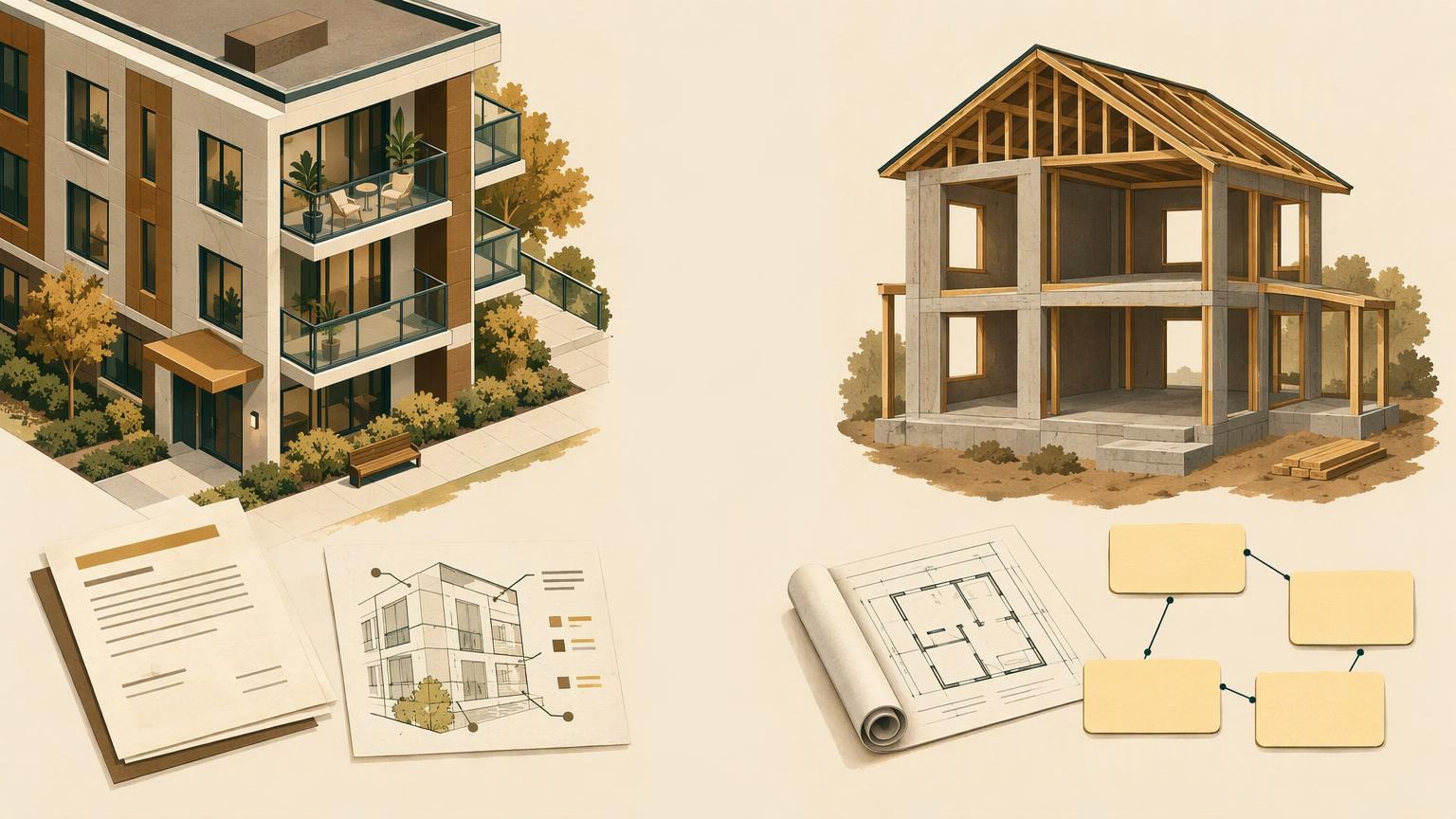
An illustration contrasts a completed condominium and an unfinished house, with document sheets and a separate building sketch on the left, and a rolled floor plan and connected blank cards on the right.
Where does The Golden Life fit?
The Golden Life provides destination and property guidance for Americans considering retirement, relocation, a second home, or investment in Mexico. Its starting point is the life you want to live, followed by location and property fit.
That is a different task from providing a legal opinion on a purchase. Clarifying intended use, budget, timing, access, wellness, and community priorities helps frame the property search; independent professionals evaluate the transaction and material facts.
The second-home and property investment planning hub provides context for connecting the purchase to those objectives. A good lifestyle fit and a satisfactory legal review are separate decisions, and both deserve attention.
For the destination-and-property starting point, The Golden Life's Find your place lets you share your priorities and send an inquiry. It does not provide legal advice or imply property availability, financing approval, or transaction terms.