
Can buying property meet Mexico residency financial requirements?

No, buying property in Mexico does not by itself establish residency. A purchase and an immigration approval are separate matters. Whether property ownership can support an application depends on the applicable requirements and the evidence accepted in your circumstances. Check your own Mexican consulate's current guidance and consult a qualified independent immigration professional before treating a property purchase as part of a residency plan.
Table of Contents
- What can buying property actually establish?
- How should you interpret a residency financial threshold?
- Which planning approach fits the purpose of the home?
- How could the decision change in practice?
- What changes when purchase money becomes property?
- What should a claim about property-based residency explain?
- Where does The Golden Life fit?
- Frequently Asked Questions
A home can fit your retirement plans without answering the immigration question. Mexico residency financial requirements concern eligibility and documentation; a property decision also concerns location, ownership structure, everyday use, and the money committed to the purchase.
The distinction matters whether you want to relocate, spend part of the year in Mexico, or own a second home. Start by separating what the home would do for your life from what an immigration authority would need to approve. This article is general educational information, not legal, tax, immigration, financing, or investment advice.
What can buying property actually establish?
A property transaction concerns rights in a property. Residency concerns permission to reside in a country. Evidence connected to the first may be relevant to an application for the second, but that does not turn the transaction into an immigration decision.
Keep those questions separate when evaluating an opportunity. A home may suit your daily life and budget, yet still leave your intended stay dependent on a separate application. Conversely, a residency plan does not establish that a particular property's title, contract, or ownership structure is suitable.
Americans can buy property in Mexico. The ownership structure depends on location and circumstances, including special structures in restricted coastal and border zones. Qualified independent legal and tax professionals are needed for any transaction.
For the broader decision about buying property in Mexico, start with The Golden Life's Buy a Second Home or Invest in Mexico page. The useful question here is narrower: would the purchase still make sense if it contributed nothing to an immigration application?
If the answer is no, the property decision depends heavily on an immigration outcome. That dependency deserves independent professional review before a purchase is treated as a route to living in Mexico.
How should you interpret a residency financial threshold?
A figure is useful only when you know which application category it belongs to, who published it, and when it applies. A number labeled a minimum investment may not answer a question about personal income, savings, or property ownership.
Likewise, the price advertised for a home is a transaction figure. Whether an immigration authority accepts that amount, another valuation, or any property evidence at all requires current official guidance and qualified interpretation.
Check the Mexican consulate handling your application, rather than assuming a figure from another location or an older article applies. Any threshold used in planning should identify the named consulate or official authority, the publication or effective date, and the date it was checked.
Identify what the figure measures
Income is a flow of money. Savings are funds held. Property value describes an asset. Those measures are not interchangeable, even when each is expressed in dollars.
A useful professional discussion distinguishes the category, the financial measure, and the supporting records. Combining unrelated figures into a single idea of how much money is needed can make an apparently affordable plan difficult to evaluate.
Separate the amount from the evidence
An amount and a document requirement answer different questions. One describes a financial measure; the other describes how an applicant is expected to demonstrate it.
Questions about whose name must appear, which records are acceptable, what period the records cover, and how amounts are interpreted belong with your consulate and an appropriately qualified immigration professional. A property brochure cannot settle them.
Keep qualification separate from living costs
A residency threshold is not a retirement budget. Even where someone can demonstrate the required financial position, the cost of their intended lifestyle remains a separate planning exercise.
Housing expenses, maintenance, travel, insurance, and everyday spending affect whether a plan is sustainable. A monthly lifestyle budget cannot establish immigration eligibility, and an eligibility figure cannot establish that a home is affordable.
Which planning approach fits the purpose of the home?
The most useful comparison is not simply buying versus renting. It is whether your property choice depends on being able to live in Mexico under a particular immigration status.
A second home used for occasional stays has a different purpose from a home intended for relocation. Neither purpose determines immigration eligibility, but each changes how consequential an uncertain residency outcome would be.
| Approach | When it deserves consideration | Main trade-off | Question it must answer |
|---|---|---|---|
| Explore residency eligibility before choosing a purchase | Living in Mexico is the main objective | Property selection may wait while the immigration question is clarified | Can the intended living arrangement proceed independently of a purchase? |
| Evaluate a second home independently of residency | The property has a useful purpose beyond relocation | Ownership does not resolve permission for the intended stays | Would the home remain worthwhile without a residency outcome? |
| Test daily life before committing to ownership | Destination or property fit is still uncertain | A temporary arrangement does not settle immigration eligibility | Does ordinary life in the destination match expectations? |
When relocation is the main objective
If the whole plan relies on living in Mexico, immigration feasibility is a separate dependency that can change the value of a purchase. Treating a home as the answer before that question is understood puts the property decision ahead of the reason for making it.
For further reading, see The Golden Life's Retiring in Mexico: A Practical First-Step Checklist. For current visa requirements, check your own Mexican consulate's guidance and consult a qualified independent immigration professional.
When the home has an independent purpose
A second home might remain useful even if relocation never happens. That makes the decision less dependent on residency, but it does not remove the need to understand the rules governing the intended use and stays.
The honest downside is that a property can be desirable while creating continuing costs and responsibilities. Its vacation appeal alone does not explain how it will be maintained or whether its use fits your plans.
| Approach | When to consider | Main trade-off |
|---|---|---|
| Explore residency first | Living in Mexico is the main objective | Property selection may need to wait |
| Evaluate a second home independently | Home is useful even without relocation | Ownership does not resolve intended stays |
| Test daily life before buying | Destination or property fit is uncertain | Testing does not settle eligibility |
How could the decision change in practice?
Say you want to retire in Mexico and are considering a home because you have heard that buying can help with residency. You like the property, but would not want to own it if you could not use it as your main home.
Compare that with someone seeking a second home who would still enjoy owning it without relocating. Both people face property and immigration questions, but the first person's purchase depends much more heavily on a residency outcome.
For the retirement plan, clarifying immigration feasibility before selecting a purchase is the more coherent planning approach. It addresses the dependency that could otherwise leave the buyer with a home that cannot serve its intended purpose.
For the second-home plan, evaluating the property independently may be reasonable as a planning approach because the home has another purpose. That still leaves the intended stays, transaction structure, costs, and use to be reviewed by the relevant independent professionals.
Now picture that the retirement buyer already has a well-developed financial plan but knows little about daily life in the destination. Testing the destination may be the more useful next lifestyle step than looking for a higher-priced property. Spending more does not answer questions about climate, community, or whether the home suits ordinary routines.
The choice follows from what remains uncertain. Immigration eligibility, destination fit, and property suitability need different evidence; resolving one does not resolve the others.
What changes when purchase money becomes property?
A purchase changes the form in which money is held. Funds previously available in an account may become tied to a property, while ownership introduces expenses and responsibilities. This is a general budgeting distinction, not a conclusion about how an immigration authority will assess your finances.
It matters because a plan can look financially strong in total while having less readily available money after closing. The financial picture used for residency planning and the budget used for homeownership should describe the position expected after the transaction, not just before it.
Whether an authority considers property value, debt, available funds, or other evidence is a question for current official guidance and an independent immigration professional. Neither a purchase price nor a financing approval establishes a residency result.
Financing may be available for qualified U.S. buyers through licensed providers. Eligibility, property requirements, underwriting, rates, terms, fees, and approval apply. The Golden Life's Mexico property financing overview is educational context for that separate question.
A qualified independent financial professional can help explain the purchase's effect on liquidity and affordability. That assessment should remain distinct from the immigration assessment and from legal review of the transaction.
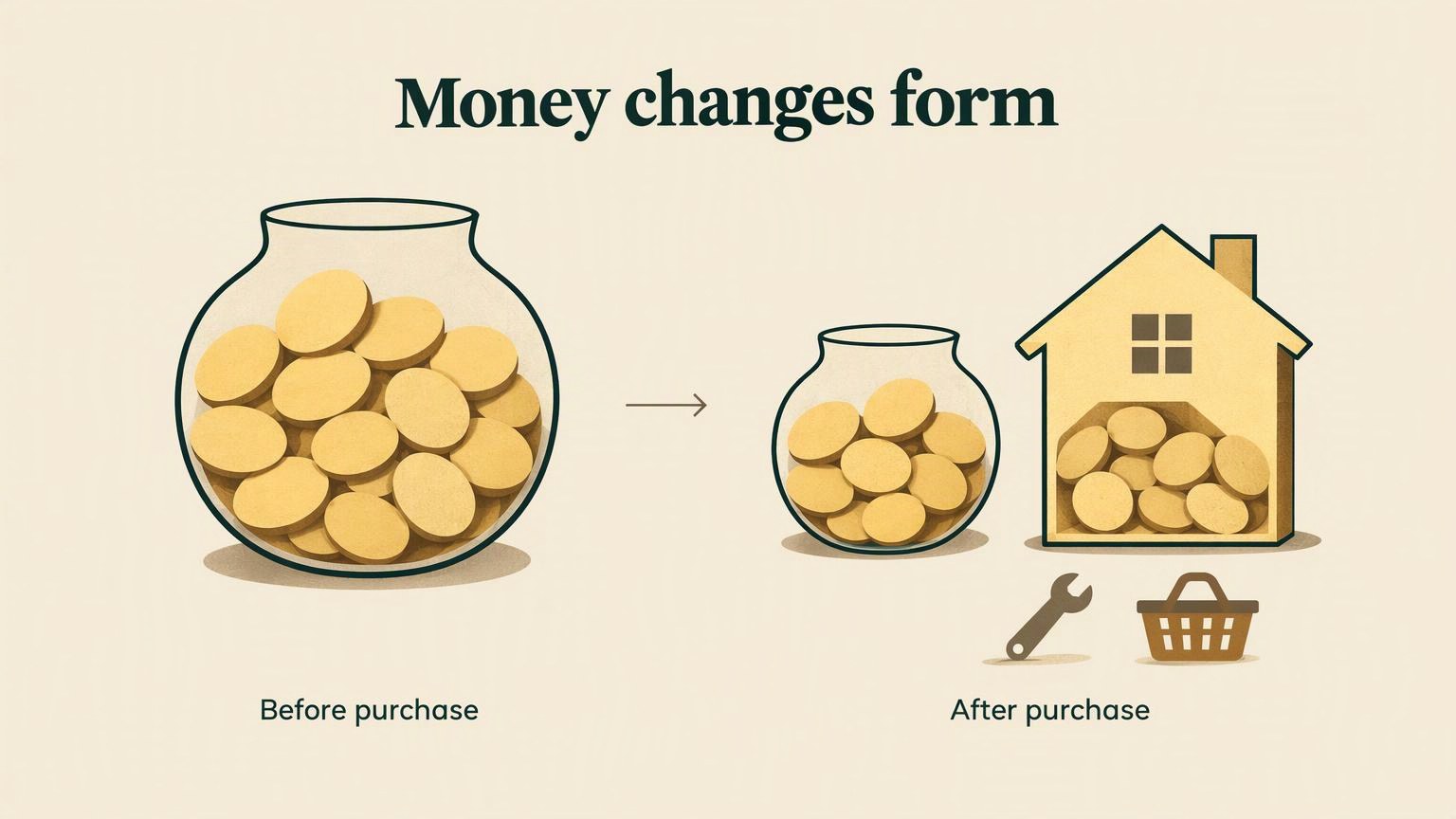
Illustration titled “Money changes form,” showing gold discs in a jar before purchase and divided between a smaller jar and a house afterward, with wrench and basket motifs.
What should a claim about property-based residency explain?
A credible explanation identifies the immigration category and the authority responsible for the decision. It also distinguishes a possible basis for applying from an approval already granted. Language suggesting that a purchase includes residency blurs that distinction.
The practical test is whether the claim can be explained without relying on a sales promise. Which current official requirements apply? What evidence would be assessed? What happens to the property decision if the expected immigration result does not occur?
Those are different questions from whether the home has clear title or a suitable contract. Independent immigration and transaction professionals may need to examine different parts of the same plan.
Warning signs include an undated financial threshold, a dollar conversion without its basis, or a promise that buying removes the need for individual review. Another is treating property ownership, residency, and citizenship as if they were the same outcome.
No property availability, financing approval, immigration approval, or legal outcome is guaranteed. A useful explanation makes the dependencies understandable rather than asking you to assume them away.

Illustration of document research, with a magnifying glass over abstract source pages and a hand holding a property brochure to one side.
Where does The Golden Life fit?
The Golden Life helps connect the life you want with destination and property direction. Its process starts with your objective, then compares fit through budget, timing, access, wellness, and community priorities.
That role is useful here because an immigration question can otherwise dominate the property search. A home selected mainly for a presumed qualifying value may be a poor match for how you want to live. Destination and property guidance keeps intended use visible while qualified independent professionals address eligibility and transaction questions.
The Find your place lets you share your priorities and send an inquiry. It does not establish immigration eligibility, financing terms, approval, or property availability.
An inquiry to The Golden Life is another way to talk through the questions that matter before investing time or money. The Golden Life's role is planning and direction, not a substitute for independent immigration, legal, tax, or financial advice.