
Can Americans buy property in Mexico? Restricted zones and financing explained

Yes, Americans can buy property in Mexico. The ownership structure depends on location and circumstances, including special structures in restricted coastal and border zones. A bank trust, called a fideicomiso, is a structure used for foreign residential buyers in those areas. Financing is a separate question and may be available to qualified U.S. buyers, subject to property requirements, underwriting, terms, fees, and approval.
Table of Contents
- What does the restricted zone change?
- How does a fideicomiso differ from a mortgage?
- Which property rights are you actually buying?
- What does financing qualification actually mean?
- How do these distinctions change a property shortlist?
- What does independent review add beyond an ownership explanation?
- Where does The Golden Life fit in the buying process?
- Frequently Asked Questions
Buying a house in Mexico as an American starts with separating permission to buy from the details of a particular purchase. A home can suit your life while its ownership documents, borrowing requirements, or usage rules need further attention.
The question "can Americans buy property in Mexico?" therefore has a clear answer, followed by several separate decisions. Location affects the ownership structure; the product determines what you acquire; financing determines how a purchase might be funded. This article provides general educational information, not legal, tax, immigration, financing, or investment advice. Individual transactions require qualified independent professionals.
What does the restricted zone change?
The restricted zone concerns the ownership structure for foreign buyers in designated coastal and border areas. It does not mean that Americans must exclude all coastal homes from their search.
For foreign residential buyers, a bank trust is a structure used in these areas. Outside the restricted zone, a different ownership route may apply, depending on the property and the buyer's circumstances. The exact parcel matters more than a broad destination label.
That distinction changes how you read a property description. "Americans can buy here" answers the nationality question, but it does not establish what title, beneficial interest, or contractual right a specific offering transfers.
A description such as "coastal property" is also not a legal determination. A qualified independent Mexican legal professional can establish how the applicable location rules relate to the parcel and intended use. A destination guide or sales description cannot substitute for that determination.
The practical trade-off is straightforward: a destination may fit your everyday life, while its ownership structure adds documentation and administration to evaluate. That additional work is a separate consideration from whether you like the home.
The Golden Life's second-home and investment planning hub provides a starting point for comparing intended use. The ownership route for an individual property still requires independent legal and tax review.
How does a fideicomiso differ from a mortgage?
A fideicomiso concerns how an interest in property is held. A mortgage concerns borrowing. The involvement of a bank in a trust does not, by itself, mean that the bank is lending the purchase money.
In a typical residential bank-trust arrangement, a Mexican bank holds title as trustee, while the foreign buyer is the beneficiary. The trust documents govern the beneficial interest and the procedures attached to it. This is different from a simple promise of vacation access.
Descriptions of these arrangements commonly discuss the beneficiary's ability to use the property and transfer the interest. The precise rights, conditions, and procedures belong in the actual documents and require explanation by a qualified independent legal professional. A general explanation is not a guarantee of any particular contract's effect.
Keeping trust and financing separate prevents a common misunderstanding. A purchase funded without a mortgage may still involve a bank trust. Conversely, the possibility of financing does not determine the correct ownership structure.
The trust also does not answer every question about the home. Property condition, the seller's authority, permitted use, and the financial obligations associated with the property remain separate matters.
For planning purposes, think of the trust as part of the ownership layer, rather than a financing offer or a blanket assurance of security. Its documents need their own review even when the borrowing question is settled.
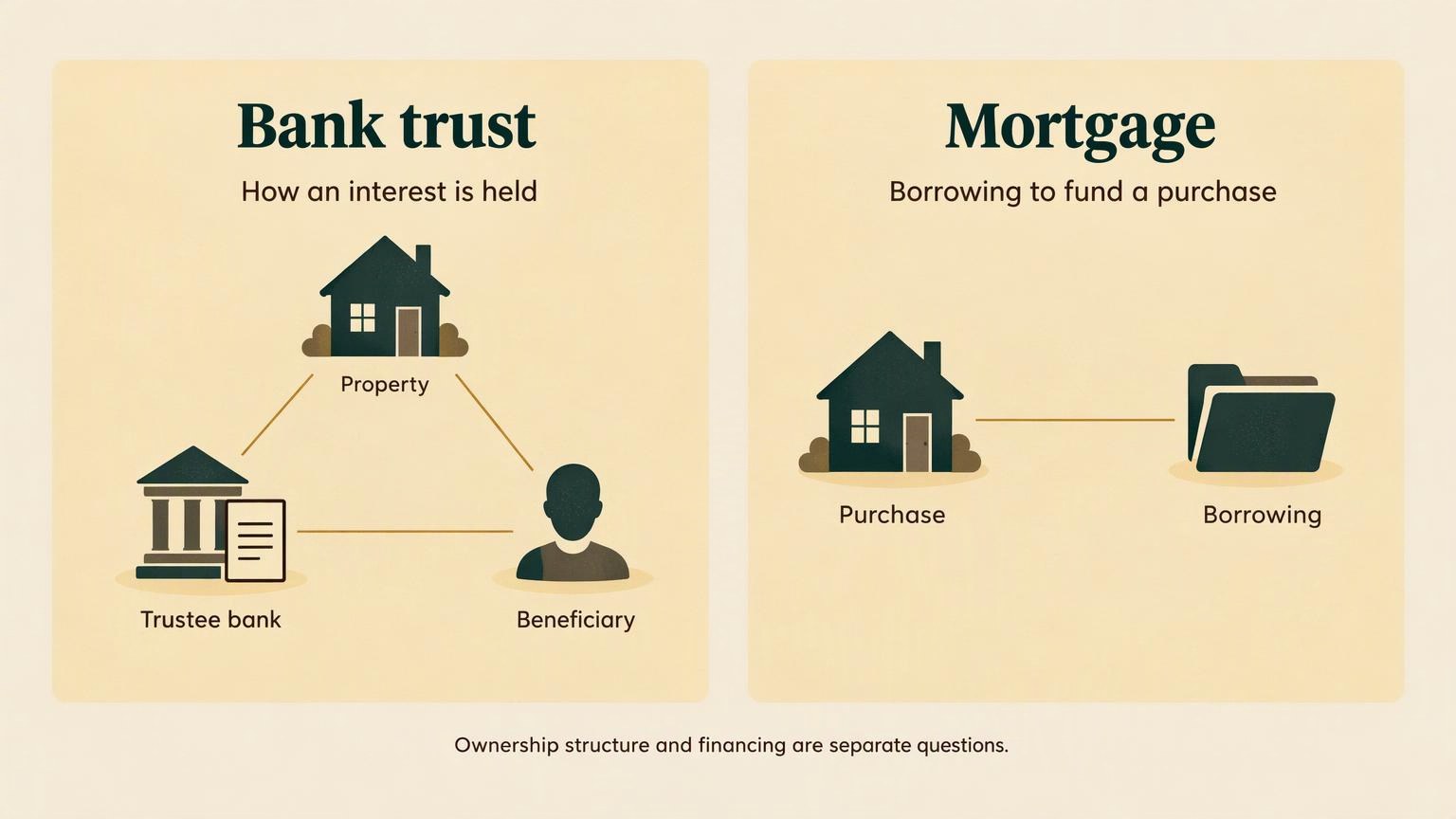
Illustration contrasting bank trust and mortgage with separate panels. The footer states: Ownership structure and financing are separate questions.
Which property rights are you actually buying?
A photograph of a home cannot tell you whether the offering is for the whole property, a fractional interest, or a right to use it at certain times. Those products can look similar in marketing while serving very different purposes.
Whole-property ownership generally puts the property's use and ongoing responsibilities within the owner's decision-making, subject to applicable documents and rules. A fractional product introduces a shared arrangement. A timeshare centers on defined usage, while land raises questions about what exists now and what might be possible later.
The comparison below describes ordinary product categories, not verified offerings from The Golden Life. The actual agreement determines the rights, usage arrangements, charges, and exit conditions.
| Product | Rights to distinguish | Usage question | Fees and responsibilities | Exit question |
|---|---|---|---|---|
| Whole-property ownership | Title or beneficial interest covering the whole property | What personal and rental uses are permitted? | Property expenses and any applicable trust or community obligations | What documents and conditions govern a transfer? |
| Fractional interest | The ownership share or contractual interest actually transferred | How are dates, scheduling conflicts, and shared use handled? | Shared expenses, management charges, and other contractual obligations | Are transfers restricted, and who controls the process? |
| Timeshare | The defined usage right and whether any ownership interest accompanies it | Which periods, booking rules, and access conditions apply? | Recurring charges and any contract-defined increases or assessments | What cancellation or transfer provisions apply? |
| Land | The parcel interest and its documented legal status | What use or construction is permitted and technically feasible? | Holding expenses and potential infrastructure or construction costs | What could limit a future transfer or development? |
Match the product to the life you intend
A shared-use arrangement may fit occasional visits, but its scheduling rules can matter more than the home's appearance. Someone planning to live in Mexico needs a different comparison: continuity of access, control over the space, and the responsibilities that come with it.
Land is another distinct decision. It is not an interchangeable substitute for a completed home because future use can depend on legal permissions and technical feasibility. None of these categories carries a promise of resale, appreciation, or rental income.
What does financing qualification actually mean?
Financing may be available for qualified U.S. buyers through licensed providers. Eligibility, property requirements, underwriting, rates, terms, fees, and approval apply. There is no universal mortgage offer for Americans buying in Mexico.
The useful distinction is between a buyer who may qualify and a property that may qualify. A favorable discussion about the buyer does not establish that every home, parcel, or ownership product will meet a provider's requirements.
Buyer review and property review are separate
Buyer review may involve income, credit, assets, residency, documentation, and underwriting requirements. Property review may involve location, title, completion status, valuation, and property type. The exact requirements depend on the provider, buyer, property, and current terms.
This explains why "financing available" is not enough information to build a purchase plan around. It needs to relate to the actual buyer and property under consideration. Financing approval is not guaranteed.
The payment is only part of the comparison
A financing discussion can include rates, terms, fees, insurance, taxes, currency, closing costs, and prepayment rules. Qualified financial and tax professionals can explain how those elements affect an individual's circumstances.
A smaller recurring payment, by itself, does not establish a lower overall cost. Likewise, an attractive property does not establish that its financing terms fit the buyer's wider financial commitments. The Golden Life's financing overview for U.S. buyers organizes these subjects without promising eligibility or terms.
How do these distinctions change a property shortlist?
Say you are considering a second home that may eventually become your primary home. You want flexible personal use, and the purchase would depend on financing.
A completed whole-property offering, a fractional offering, and an undeveloped parcel may all appear in your search. They are not equivalent choices just because each is described as property in Mexico.
The whole-property option is the clearest product to investigate for continuous future use, but its ownership documents and financing eligibility remain separate questions. A fractional option could suit occasional visits if its scheduling and control provisions match that purpose; it may be a poor fit for an eventual full-time move.
The land option introduces another dependency: acquiring a parcel does not establish that a suitable home can be built or funded as intended. Its apparent potential is different from having a completed place to live.
For this reader, whole-property options would be the most relevant category to explore first because the goal includes continuous occupancy. That is a product-fit conclusion, not a recommendation to buy a particular property or use a particular financing structure.
Change the goal to limited seasonal visits with no plan to relocate, and a shared-use product could deserve more attention. The choice follows intended use, documented rights, and funding requirements, rather than a universal ranking.
| Product | Fit for this goal | What to verify |
|---|---|---|
| Whole-property | Explore first for continuous occupancy | Ownership documents; financing eligibility |
| Fractional | May fit visits, not a full-time move | Scheduling and control provisions |
| Land | Not yet a completed place to live | Building and funding feasibility |

Illustration of three property-option cards beneath an occasional-visits-to-continuous-living strip, with separate documented-rights and financing-eligibility questions. A hand holds the land card.
What does independent review add beyond an ownership explanation?
Understanding that Americans can buy property establishes a starting point. Independent review addresses whether a particular transaction's documents, property, and obligations support the proposed purchase.
Legal review concerns the interest being transferred, the seller's authority, applicable ownership structure, and contractual conditions. Technical review concerns the physical property and its suitability for the intended use. Financial and tax review address different questions again.
These reviews are complementary. A positive assessment of the building's condition does not establish the legal effect of a contract. A financing approval does not establish that a home suits your daily life or that a future rental plan will work.
Timing matters through dependencies rather than a universal closing schedule. A purchase depending on financing differs from one whose funding is already established. A completed home differs from an offering where delivery or future construction is part of the proposition.
Deposits and contractual deadlines also deserve their own professional explanation. There is no single deposit percentage or closing timetable that can safely stand in for the terms of an individual agreement.
Useful review produces more than reassurance: it explains what the documents establish, which obligations continue after purchase, and what assumptions remain outside the agreement. Appropriately qualified independent legal, tax, technical, and financial professionals provide that transaction-specific work.
Where does The Golden Life fit in the buying process?
The Golden Life begins with the life you want to live, then connects destination and property direction to that objective. Retirement, relocation, a second home, and rental use can point toward different property categories even within the same destination.
Its process considers budget, timing, access, wellness, and community priorities before individual opportunities. A curated property-shortlist request can be organized around destination, budget, timing, and use. A discovery visit can connect shortlisted communities with the questions that still require independent verification.
This is useful before comparing listings because it separates personal fit from transaction mechanics. Destination guidance helps define what belongs in a search; it does not approve financing, establish legal rights, or replace professional due diligence.
The Next-Chapter Planner provides a planning framework before comparing individual opportunities. For a personalized starting point, the Find your place lets you share your priorities and send an inquiry.
An inquiry to The Golden Life can introduce your intended use and the questions you want to discuss. Property availability, financing approval, pricing, legal outcomes, appreciation, rental income, and returns are not guaranteed.