
Buying pre-construction in Mexico: deposits, delays and protection

Buying pre-construction in Mexico means committing money before the property is complete. The central risks are how much you pay before delivery, what happens if work stalls, and whether promised protections work as described. Compare those uncertainties with an existing property and your intended use. Qualified independent legal, technical, and financial professionals are needed to evaluate a particular transaction; no payment structure guarantees completion or recovery.
Table of Contents
- How does pre-construction compare with an existing property?
- What does a presale deposit actually expose you to?
- How are payment controls different from refund promises?
- What does a delivery date actually mean?
- What evidence answers 'what is ready today'?
- How does your intended use change the choice?
- Where does The Golden Life fit before commitment?
- Frequently Asked Questions
A presale can make a future home feel tangible long before it is usable. A floor plan shows the rooms, a rendering shows the finished building, and a payment schedule gives the purchase a sense of order. None establishes what is ready today.
For you, buying pre-construction in Mexico is a decision about timing and dependence as much as property. If the home will support retirement, seasonal visits, or rental use, unfinished work can change the entire plan. The useful comparison is between what exists, what remains promised, and how each payment changes your exposure.
How does pre-construction compare with an existing property?
A presale asks you to evaluate both a property and a future delivery process. An existing home lets you assess more of the physical result, although its condition, documentation, fees, and suitability still need independent review.
There can be a genuine appeal to buying before completion: a particular layout, location, or planned community may fit your intended life. The downside is dependence on work and decisions that have not yet happened. Neither a new building nor an attractive sales presentation resolves that dependence.
The Golden Life's second-home and investment framework for Mexico begins with intended use. A home needed for a planned move presents a different timing decision from a second home you can wait to use.
| Property stage | What can be assessed physically | What still needs evaluation | Timing trade-off |
|---|---|---|---|
| Presale before construction | The site and any existing infrastructure | The proposed home, approvals, payment terms, and delivery obligations | Use depends on future construction and other outstanding steps |
| Property under construction | Visible work completed at the inspection date | Remaining work, specifications, utilities, documentation, and payment triggers | Progress is observable, but the usable delivery date still needs verification |
| Completed or resale property | The actual home and existing common areas | Condition, ownership documentation, operating arrangements, and suitability | More can be inspected now, but completion alone does not establish transaction readiness |
| Property stage | Assess physically | Still evaluate | Timing trade-off |
|---|---|---|---|
| Presale before construction | Site and existing infrastructure | Approvals, payment terms, delivery | Use depends on future construction |
| Under construction | Visible work at inspection date | Remaining work, utilities, documents | Usable delivery date needs verification |
| Completed or resale | Actual home and existing common areas | Condition, ownership, operating setup | Completion is not transaction readiness |
What does a presale deposit actually expose you to?
The useful starting point is the relationship between money committed and the result delivered. An initial deposit and later installments may have different purposes, release conditions, and cancellation consequences. The word deposit does not tell you whether the money remains held separately, has been released, or can be recovered.
Payment exposure is therefore broader than the first transfer. It includes amounts already paid, later obligations, and the circumstances under which those obligations continue. A small opening payment does not describe the exposure created by the full schedule.
Calendar payments and construction milestones answer different questions. A calendar installment becomes due because time has passed; a milestone payment, if the agreement provides for it, depends on a defined event. The significance of either structure depends on the actual wording and administration.
A milestone needs a definition and a verifier
For example, a payment described as due at structural completion raises separate questions: what counts as complete, who confirms it, and what evidence supports that confirmation? Progress photographs may help explain work, but they are not the same as an independent technical assessment.
These are topics for qualified independent legal and technical review. A milestone label by itself does not establish that the payment mechanism limits exposure or that the completed work meets the promised specifications.
How are payment controls different from refund promises?
A payment control concerns where money sits and the conditions for releasing it. A refund provision concerns what happens after a specified event. Those are different protections, and neither should be inferred from reassuring language in a sales conversation.
If an arrangement is described as escrow, the useful subjects include the holder, account structure, written instructions, release conditions, and dispute process. A qualified independent professional can evaluate the arrangement actually proposed. This article does not establish that any project has escrow or that any particular arrangement protects a buyer.
A refund promise also needs more than a headline. Its practical meaning depends on the triggering event, exclusions, deductions, procedure, and the counterparty's ability to fulfill the obligation. A contractual remedy and successful recovery are not interchangeable.
Read obligations in both directions
A presale agreement may address late delivery and missed buyer payments differently. Those provisions belong in the same review because your obligations may continue while construction is delayed.
The educational distinction is between a promised outcome, a process for pursuing it, and the practical ability to obtain it. Whether a clause is valid, enforceable, or appropriate in a particular transaction requires qualified independent legal advice. No clause guarantees completion or repayment.
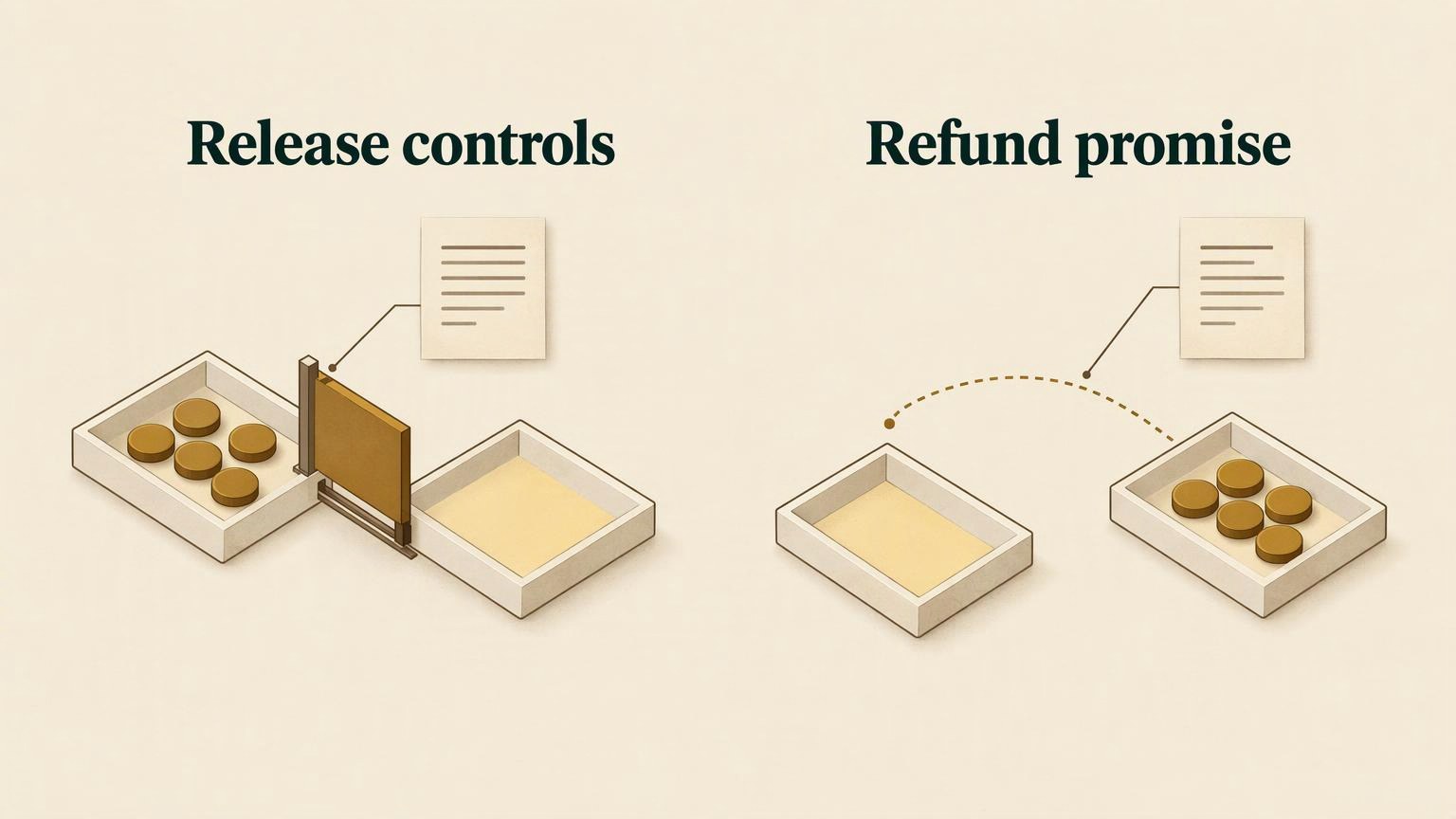
Illustration contrasting Release controls, with tokens behind a gate linked to a document, and Refund promise, with tokens in a separate tray and a dotted path stopping short of an empty tray.
What does a delivery date actually mean?
A date has little decision value without a defined deliverable. The relevant questions include whether it refers to completion of the unit, access to the building, operation of utilities, completion of common areas, or another event specified in the agreement.
A building can look nearly finished while steps affecting everyday use remain outstanding. Conversely, a usable unit does not establish that every advertised amenity or ownership-related document is ready. Physical condition, practical usability, and transaction documentation need separate evaluation.
General review topics include how the agreement describes the date, any extension provisions, what notice accompanies a change, and what happens if the stated conditions are not met. Their legal effect is a matter for independent counsel, not an inference from a brochure.
Delay affects your life plan as well as the building
If your move depends on delivery, a delay can leave you needing another place to live while the purchase remains incomplete. If the property is intended for rental use, unfinished delivery also means the planned use cannot begin as expected; rental income is not guaranteed even after completion.
A useful planning comparison separates the purchase schedule from the date you actually need a usable home. The more tightly those dates are linked, the more delivery uncertainty matters. Qualified financial professionals can assess the implications for your circumstances.
What evidence answers 'what is ready today'?
The phrase is useful because it separates current conditions from future commitments. A rendering explains an intention. A dated inspection describes conditions at a particular time. Neither replaces the documents and professional assessments needed for a transaction.
Different evidence answers different questions. Construction progress cannot establish title, and a permit document cannot establish workmanship. Treating one positive finding as proof of everything else can hide the remaining dependencies.
- Physical evidence concerns the actual unit, building, and work remaining, assessed by an appropriately qualified independent technical professional.
- Project documentation concerns the applicable authorizations and whether they relate to the project and work being sold, evaluated by qualified professionals.
- Ownership and contracting evidence concerns the parties, their authority, the property involved, and the proposed transaction structure, evaluated by independent legal counsel.
- Operating evidence concerns utilities, access, common areas, management arrangements, and the practical conditions for intended use.
The date of each item matters. An old inspection or progress update describes an earlier condition, not necessarily the present one. Evidence also needs to match the actual unit or phase rather than another part of the community.
Independent verification can clarify what is known and what remains dependent on future action. It cannot remove every construction, counterparty, or transaction risk.
How does your intended use change the choice?
Say you are planning to retire in Mexico and want the property to become your everyday home when you leave your current residence. You like a presale's layout, but its future delivery date and operating conditions have not been independently established.
For that reader, an existing property is the more directly assessable category because the home itself can be inspected now. It may offer fewer opportunities to influence the finished design, and its condition still needs review. But it allows the comparison to focus more on an existing result rather than a promised one.
Now picture someone keeping a primary home in the United States and considering a future seasonal residence. That person's use date may be more flexible. Presale remains a possible category to evaluate, provided the uncertainty is understood rather than treated as a guaranteed timetable.
The difference is not that retirement buyers must avoid presales or second-home buyers should choose them. It is the consequence of non-delivery or delay. The same payment schedule can interact very differently with a fixed move plan and a flexible future-use plan.
For an income-oriented purchase, the comparison needs another layer: the assumptions behind intended rental use, operating expenses, and financial dependence on that income. Those matters require supporting evidence and qualified financial or investment advice. A sales projection does not establish a return.

An illustration contrasts “Planned move,” with boxes and a path stopping before an unfinished house, against “Flexible future use,” with an open travel bag and a dotted path toward a house outline.
Where does The Golden Life fit before commitment?
The Golden Life begins with the life you want to live, then connects that objective with destination and property direction. For a presale decision, that means keeping retirement, relocation, second-home, investment, and rental intentions distinct instead of treating every property as interchangeable.
That starting point helps frame the category comparison: does your intended use depend on a home that is usable now, or can you evaluate a future-delivery option without assuming completion? Budget and timing belong alongside access, community, and everyday lifestyle priorities.
The Find your place lets you share your priorities and send an inquiry. It is an initial direction-setting step, not a substitute for evaluating the actual agreement, building, or ownership documents.
All content here is general educational information, not legal, tax, financing, or investment advice. Material facts require independent verification, with appropriately qualified legal, tax, technical, and financial professionals for your circumstances. Property availability, financing, approval, pricing, appreciation, rental income, returns, and legal outcomes are not guaranteed.